
Start Dog Reactivity Training Below Your Dog’s Threshold
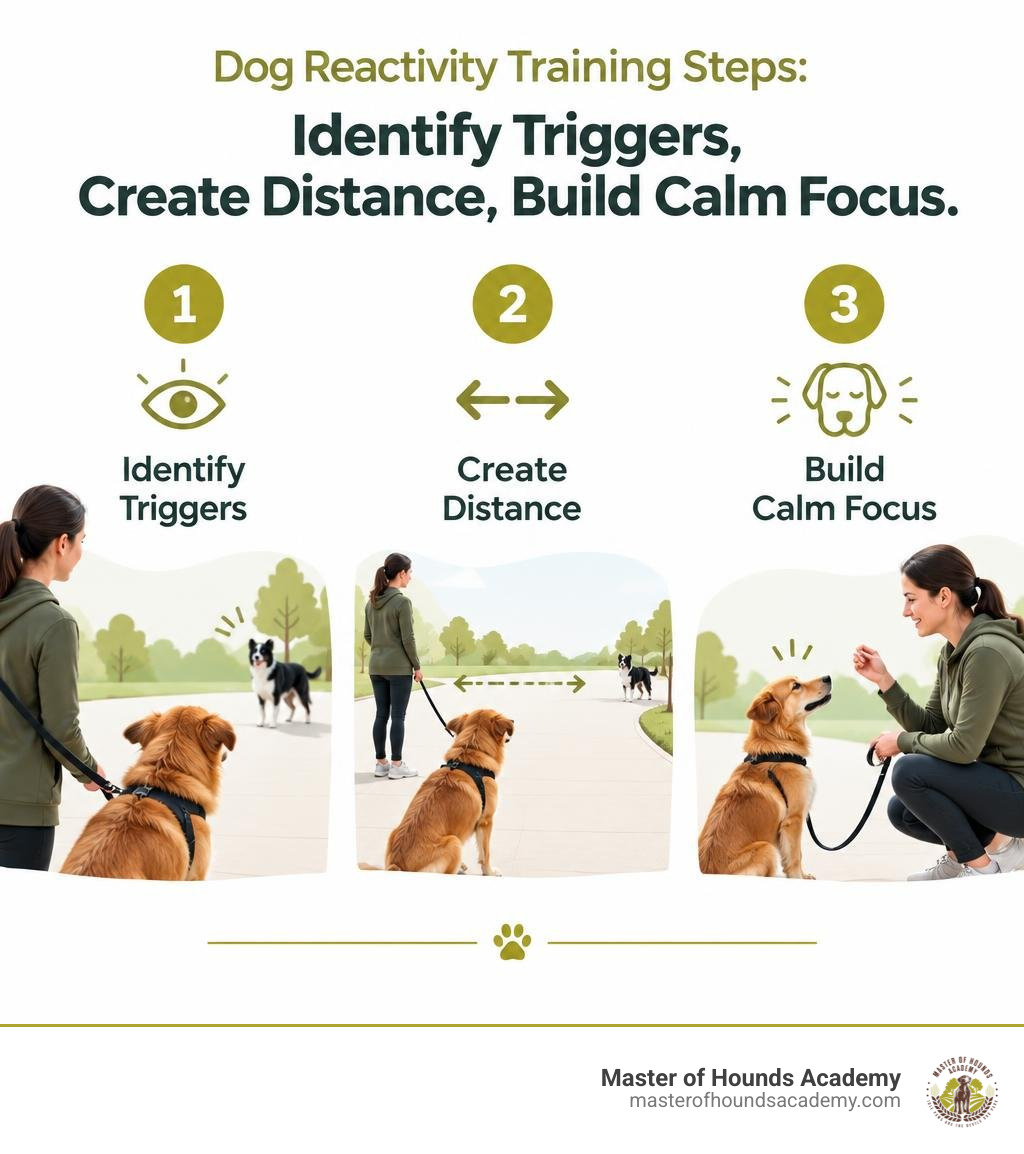
Effective dog reactivity training starts by keeping your dog far enough from a trigger that they can notice it without barking, lunging, freezing, or losing focus. Then, build calm behavior in short, controlled sessions:
- Identify triggers and note the distance where your dog can still respond to you.
- Create more space before your dog becomes overwhelmed.
- Reward calm choices, use clear leash guidance and boundaries, and end on a successful repetition.
Reactivity is often a fear, frustration, or overarousal response, not proof that your dog is “bad.” A painful condition, poor past experiences, trigger stacking, or a lack of social skills can also play a part. Safety and steady practice matter more than forcing close encounters.
I am Francis Metcalf, founder and co owner of Master of Hounds Academy in Walnut Creek, California, serving families throughout the Bay Area and Northern California. With more than two decades in the dog training field, I use personalized dog reactivity training to help dogs and their families build safer, calmer lives together.
Dog reactivity training terms you need:
Understanding Canine Reactivity: Causes, Triggers, and Nervous System Responses
Living with a reactive canine companion can feel isolating, especially when a quiet morning stroll through your neighborhood turns into an explosive moment at the sight of another dog across the street. At its foundation, canine reactivity is an automatic nervous system reaction. When a dog perceives an environmental trigger, the sympathetic nervous system activates the classic fight or flight response. The brain releases adrenaline and cortisol, shifting cognitive function away from thoughtful learning and directly into immediate self preservation.
Reactivity is rarely a desire to dominate or act out maliciously. Instead, it stems from genuine underlying emotional drivers:
- Fear and Insecurity: The dog feels unsafe and uses loud, explosive displays like barking or lunging to force the scary stimulus to move away.
- Barrier Frustration: High drive, social dogs restrained by a leash or fence often experience extreme arousal because physical barriers prevent them from greeting or investigating, which quickly turns into agitation.
- Trigger Stacking: Stressors accumulate over hours or days. A morning siren, an unexpected delivery person, and a loud motorcycle can leave your dog on edge, causing them to erupt at a minor sight they would normally ignore.
- Genetics and Early Development: Innate breed traits, lack of early neutral exposure, or traumatic past experiences heavily influence how the central nervous system processes everyday input.
Recent Cognitive research on environmental stimulus processing demonstrates that how an organism perceives environmental stress shapes behavioral outcomes. For owners seeking a structured foundation, our step by step guide to behavioral training for anxious dogs explores how anxiety drives these sudden physical outbursts.
| Characteristic | Fear Based Reactivity | Predatory or Frustration Arousal |
|---|---|---|
| Primary Motivation | Create physical distance from a perceived threat | Gain access to a target or satisfy chasing instincts |
| Body Posture | Weight shifted backward, low tail, pinned ears, lip licking | Weight pitched forward, tall stance, stiff tail, intense eye lock |
| Vocalization | High pitched alarm barking, nervous growling, whining | Deep barking, sharp baying, or high arousal shrieks |
| Recovery Time | Prolonged, requires quiet decompression to settle | Rapid return to neutral once the stimulus leaves the visual field |
Core Principles of Balanced Dog Reactivity Training

True behavioral rehabilitation requires more than surface level management. We must teach the dog how to process environmental stress, make deliberate choices, and regulate internal arousal. At Master of Hounds Academy, we apply balanced methods rooted in all four scientific quadrants of operant learning alongside classical conditioning. By pairing clear boundaries with meaningful rewards, we create predictable communication channels that relieve anxiety.
To learn more about our philosophy, explore our step by step guide to balanced dog behavior training.
Establishing Threshold Baselines in Dog Reactivity Training
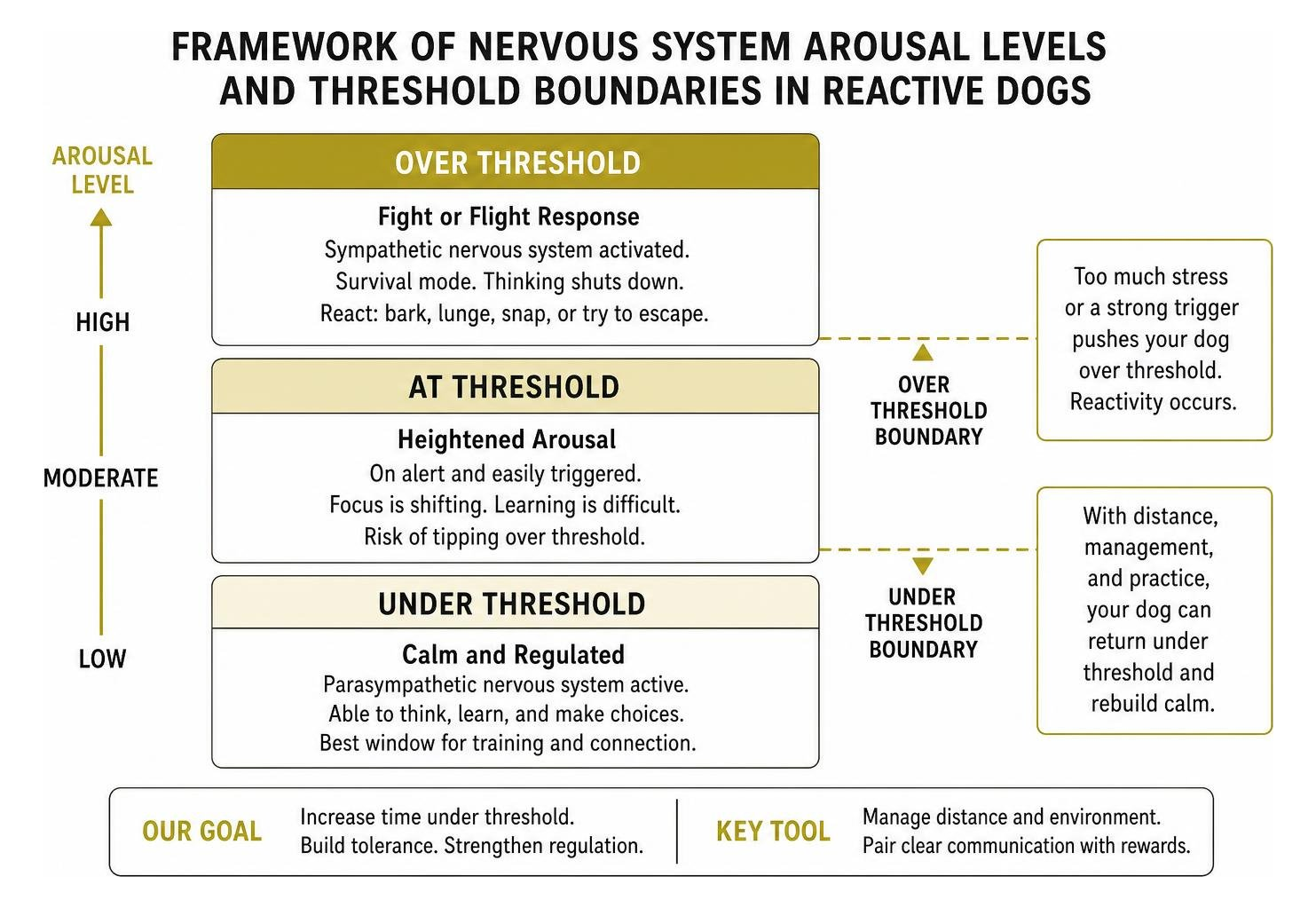
The threshold baseline represents the exact distance and environment where your dog notices a trigger while still maintaining the ability to think, accept guidance, and regulate their emotions. Once your dog crosses this line into over threshold arousal, their executive cognitive function shuts down.
Identifying these baselines requires keen observation of subtle body language markers:
- Green Zone (Under Threshold): Soft facial muscles, loose body posture, responsive ear orientation, willingness to accept high value food, and immediate responses to handler cues.
- Yellow Zone (Approaching Threshold): Stiffening spine, hyper focused stare, closed mouth, sudden cessation of panting, or subtle yawning. This is your cue to create distance immediately.
- Red Zone (Over Threshold): Hard eye contact, lunging, snapping, sustained barking, and complete inability to hear handler cues.
Recognizing these stress markers prevents dangerous escalations. For deep insights into identifying defensive behaviors, review an essential guide to fear aggression dog training.
Implementing Operant Conditioning in Dog Reactivity Training
Operant learning helps your dog understand the direct relationship between their choices and the resulting outcomes. When we teach a dog that disengaging from an overwhelming stimulus brings clarity, relief, and valuable rewards, their emotional state transforms over time.
We utilize clear reinforcement markers to capture exact moments of voluntary focus, supported by structured pattern games and dependable leash mechanics. For an indepth look at refining your timing and mechanics, read one simple way to master behavior modification methods.
Step by Step Protocol to Manage and Modify Reactive Behavior

Modifying reactive patterns requires a progressive framework that builds reliable neutrality in real world settings. If you are starting fresh with a new companion, our guide on how to start dog training in 3 simple steps for lasting results sets the baseline.
Environmental Management and De escalation Techniques
Management prevents your dog from rehearsing unwanted behaviors while you lay new neural pathways. Every explosive episode reinforces the neural pathway that connects the sight of a trigger with an adrenaline spike.
- Visual Barriers: Use frosted window film at home, park away from busy park entrances, and use vehicles or parked hedges as temporary visual screens during daily outings.
- Emergency U Turns: Teach a fast, cheerful pivot away from unexpected triggers on neighborhood walks before your dog locks eyes with another animal.
- Decompression Walks: Provide routine walks on a long line in quiet, open natural spaces without trigger exposure to allow cortisol levels to dissipate naturally.
When handling intense responses, review the ultimate guide to safe dog aggression solutions for safety measures.
Progressive Desensitization and Counter Conditioning
Progressive work alters the underlying emotional association with triggers through systematic, low intensity exposures.
- Step 1: Neutral Engagement. At a safe distance where your dog is relaxed, allow them to observe a trigger for one second. Mark the calm observation and reward them away from the trigger.
- Step 2: Voluntary Disengagement. Once your dog expects a reward upon seeing the trigger, pause and wait for them to look back at you independently before marking and rewarding.
- Step 3: Controlled Parallel Walking. Introduce a neutral helper dog walking parallel at a secure baseline distance, gradually closing the gap over multiple sessions as both dogs remain neutral.
If you are beginning this journey, consult our beginners guide to safe dog aggression solutions for clear step by step handling instructions.
Structured Environments: When to Choose Private Lessons vs. Group Classes
Determining the right environment for your dog depends entirely on their current threshold capacity and emotional stability:
- Private Lessons: Essential for dogs dealing with severe reactivity, intense fear responses, or handlers seeking tailored one on one coaching. Private settings eliminate surprise triggers, allowing us to build reliable handler mechanics and foundational engagement.
- Group Classes: Appropriate only after a dog demonstrates dependable focus around distant distractions. A structured group environment offers controlled proofing with handlers who respect working space.
To evaluate whether your dog is ready for social proofing, consult The definitive guide to finding local dog group classes and explore our curated group classes.
Frequently Asked Questions About Dog Reactivity Training
What is the difference between reactivity and aggression?
Reactivity describes an oversized behavioral reaction to normal environmental stimuli, typically fueled by internal fear, hyperarousal, or frustration. Aggression involves intent to do physical harm. While unchecked reactivity can spill over into defensive aggression if a dog feels trapped, most reactive dogs simply want to create space or resolve intense social frustration.
How long does it take to rehabilitate a reactive dog?
Modifying behavior is a biological process involving neural adaptation and confidence building. Most owners observe noticeable shifts in threshold distance within four to eight weeks of steady practice. Long term stability depends on trigger frequency, handler consistency, and allowing adequate recovery time when trigger stacking occurs.
Can adult dogs overcome severe reactivity?
Yes. Thanks to canine neuroplasticity, dogs of any age can learn new emotional associations and alternative coping skills. While managing an adult dog requires patience and structured environmental setups, balanced training provides the clarity mature dogs need to feel secure.
Transforming Reactivity into Reliable Focus
Rehabilitating a reactive dog is a journey that deepens the bond between you and your companion. With clear guidance, patience, and balanced handling, chaotic outings can transform into relaxing neighborhood adventures.
At Master of Hounds Academy, owners Francis Metcalf and Kylie Ghim bring more than thirty years of family owned experience to our community in Walnut Creek, California. Whether you require comprehensive board and train programs or personalized private lessons across the Bay Area and Northern California, our holistic Metcalf Method helps you build lasting harmony with your dog.