
Build a Recall Your Dog Can Trust in 30 Days
Reliable recall training for dogs starts simple: use one clear cue, call your dog only when you can help them succeed, reward the return right away, and slowly add distance and distraction. Practice short sessions every day, begin indoors or in a fenced area, and use a long line outside until your dog has earned more freedom.
A dependable recall is not just polite. It can stop a chase, prevent a dash toward traffic, and make park days, trail walks, and family outings far less stressful. Over the next 30 days, you will build the habit in small steps, from easy indoor turns toward you to real world recalls around tempting distractions.
I am Francis Metcalf, founder and co owner of Master of Hounds Academy, with more than two decades in dog training alongside a team that takes a personal, behavior based approach. In this guide, I will show you how recall training for dogs can become a clear, reliable skill for puppies, adolescents, and adult dogs alike.
Foundations of Reliable Recall Training for Dogs
True reliability in dog training is built on clear communication, strong motivation, and clarity across all learning moments. A dog deciding whether to return across an open park is balancing two choices: staying with an exciting scent or sprinting back to you. Our job is to tip that balance completely in your direction.
We achieve this by utilizing clear operant conditioning principles within a framework of balanced dog behavior training. When your dog hears their recall cue, it must signify an unambiguous event. Every recall repetition teaches your dog that returning swiftly yields immediate value, clarity, and safety. Leading veterinary behaviorists at UC Davis Vet Med emphasize that setting up the environment to prevent failure while establishing clear rewards is the cornerstone of lifelong safety.
By understanding your dog’s unique drive, whether motivated by real meat treats, an energetic game of tug, or personal praise, we turn coming when called into an automatic muscle memory response.
Essential Equipment for Recall Training for Dogs
Having the proper tools on hand makes managing safety and progress effortless. Before starting your thirty day program, gather these foundational items:
- Biothane Long Line: A fifteen to thirty foot waterproof long line that drags easily without tangling on brush or collecting mud.
- Standard Flat Collar or Fitted Harness: Secure gear that gives you clear control without slipping off.
- Acoustic Recall Whistle: A consistent, emotion free acoustic signal like an Acme whistle that carries sound over long distances and wind.
- Hands Free Treat Pouch: Quick access to rewards ensures pristine marker timing.
- High Value Food Rewards: Real roast beef, hot dogs, liver, or string cheese cut into pea sized bites that easily outcompete environmental smells.
- High Drive Toy: A favorite ball or tug toy reserved strictly for high energy recall celebrations.
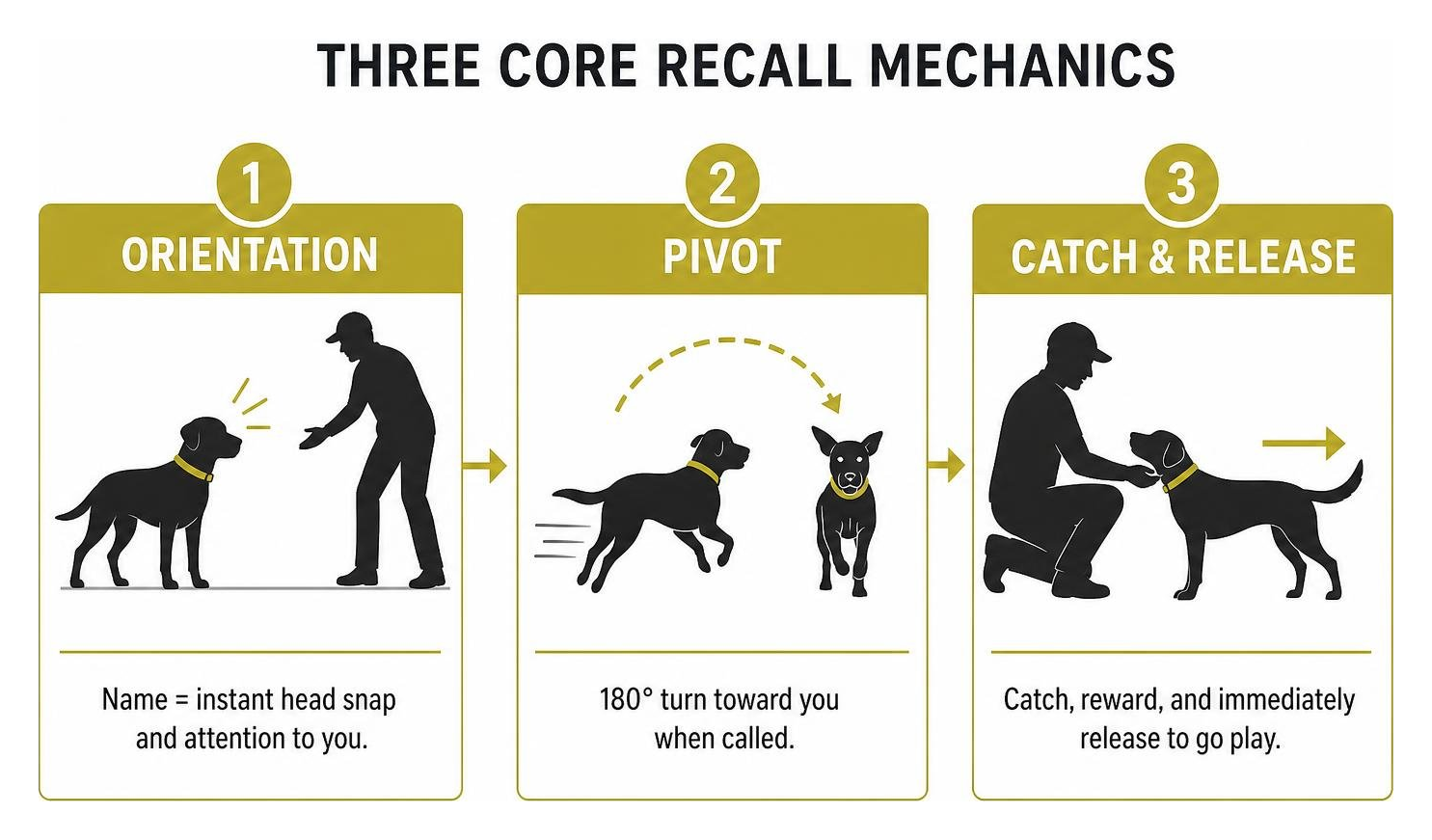
Core Mechanics: Orientation, Pivots, and Catch and Release

Before calling your dog from fifty feet away, you must master the fundamental movement patterns that create a responsive companion.
First is the rapid orientation response. When you say your dog’s name, their head should snap toward you instantly. We build this through basic focus games, establishing strong puppy training foundations that teach eye contact as the prerequisite for every cue.
Next comes the one hundred and eighty degree pivot. When a dog is running away from you, calling them requires them to spin entirely around mid stride. Practice this up close by tossing a low value piece of kibble a few feet away, then calling your dog’s name the exact second they finish eating it. As they spin around to face you, mark with a crisp verbal “Yes!” and deliver a jackpot of high value meat at your legs.
Finally, introduce the catch and release drill. A massive mistake many owners make is calling their dog, snapping on the leash, and dragging them home. Dogs quickly realize that coming to you ends their outdoor fun. With catch and release, call your dog, gently grasp their collar, feed them three delicious treats in a row, and immediately release them back to their sniffing or playing with a cheerful “Go play!” This completely removes any negative association with your recall.
The Step by Step 30 Day Recall Training Protocol
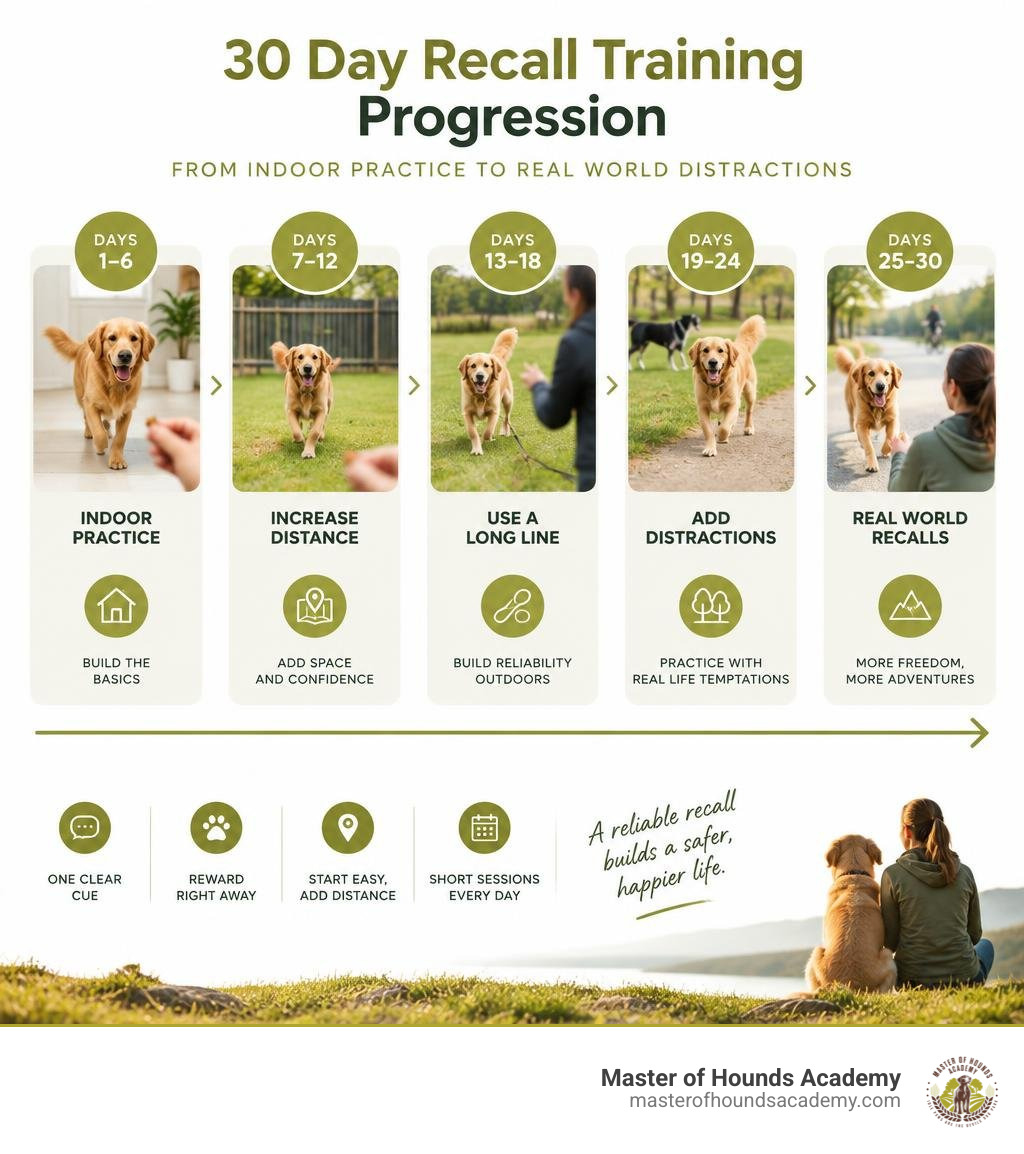
Achieving total off leash reliability requires a deliberate, step by step progression. We do not skip levels. We advance only when your dog demonstrates consistent responsiveness at their current stage. As outlined in Gundog Journal’s guide to reliable recall, working dogs achieve world class recall by systematically layering distance, acoustic cues, and real field distractions over time.
Week 1: Establishing the Cue in Low Distraction Spaces
Your initial seven days focus on creating a powerful association with your chosen recall word, such as “Here” or “Come”. Conduct these sessions inside your living room, hallway, or quiet garage where environmental stimulation is near zero.
- Name and Mark: Stand three feet from your dog. Say their name. When they look at your eyes, mark “Yes!” and feed.
- Short Recalls: Take two steps backward, call “Come!” in an upbeat, welcoming voice, and reward generously when they reach your hands. If you are starting fresh with a new dog, follow our simple dog training steps to keep baseline obedience engaging and clear.
- The Hallway Sprint: Have a family member gently hold your dog by the chest while you run fifteen feet down the hallway. Turn around, call your cue, and have your helper release the dog. Reward their enthusiastic sprint with high value food and energetic praise.
Practice two to three short sessions daily, lasting five minutes each. Never repeat the cue if your dog does not respond; simply reduce distance and reset.
Week 2: Expanding Distance with Long Lines and Whistles
Move your training outside into a secure backyard or quiet, fenced tennis court. Attach your fifteen to thirty foot biothane line to maintain complete safety.
During Week 2, introduce the acoustic whistle. A whistle provides a distinct, uniform tone that sounds identical regardless of whether you are tired, frustrated, or excited. Blow two short, sharp whistle blasts just as you vocalize your verbal recall cue. Within a few dozen repetitions, your dog will pair the whistle sound directly with the recall behavior.
Incorporate restrained recall games outdoors. Have a helper hold your dog on their long line while you jog twenty feet away holding an enticing toy or treat pouch. Wave your hands, blow your recall whistle, and let the helper release them. As your dog closes the distance, step backward to encourage driving speed right into your center.
Week 3: Proofing Against Moderate Distractions
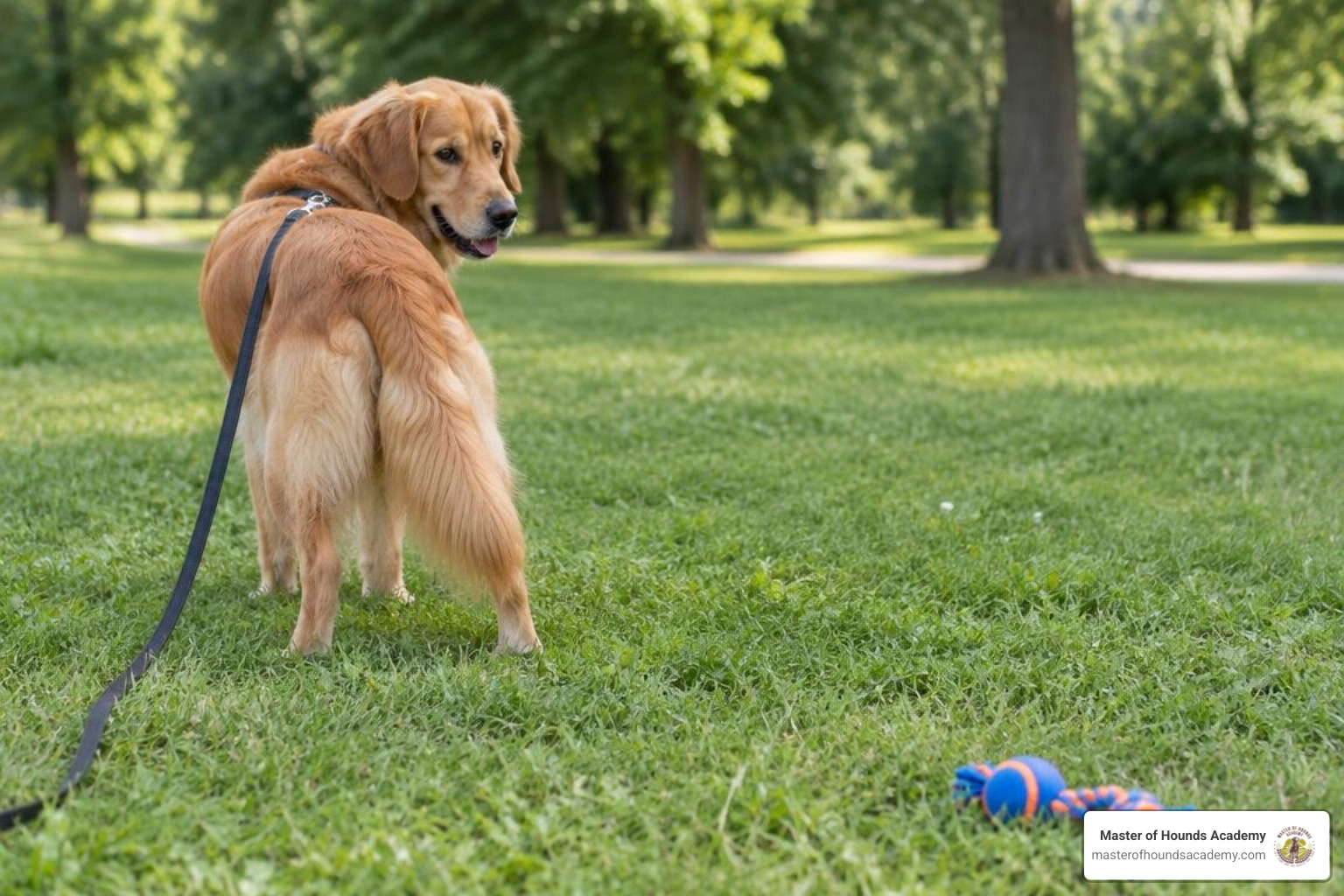
Week 3 transitions your practice to neighborhood parks, quiet trails, and open greenbelts across the East Bay. Even when applying older dog training techniques, proofing against real world novelties requires gradual, controlled exposure.
Set up the classic cookie chair exercise:
- Place a low value piece of biscuit on a lawn chair or bench ten feet away from your training line.
- Walk your dog on the long line parallel to the chair at a distance of fifteen feet.
- When your dog glances toward the chair, immediately give your recall cue and back away.
- When your dog chooses to turn away from the chair distraction and sprint to you, reward them with a super jackpot of steak or chicken.
This drill teaches your dog that turning away from moderate environmental items leads to far greater value in your hands.
Week 4: Real World Generalization and Off Leash Reliability
During the final week, practice in varied environments with high natural distractions, such as open fields, beach areas, or park perimeters with squirrels and distant dogs.
Vary your reinforcement schedule. Instead of rewarding with a single treat every time, deliver random surprises: sometimes a single piece of kibble, sometimes a jackpot of roast beef, sometimes a vigorous game of tug, and sometimes enthusiastic physical affection followed by immediate release back to play.
| Distraction Tier | Example Environment & Stimuli | Line Management | Optimal Reward Strategy |
|---|---|---|---|
| Tier 1: Low | Quiet indoor living room, empty hallway | Dropped 6 ft leash | Standard treats, kibble, calm verbal marker |
| Tier 2: Moderate | Fenced backyard, quiet suburban sidewalk | 15 ft Biothane line | Freeze dried liver, string cheese, short tug play |
| Tier 3: High | Park with squirrels, distant walking dogs | 30 ft dragging line | Warm roast beef, hot dogs, high value ball toss |
| Tier 4: Extreme | Active trails, off leash dog parks, wildlife | Handled 30 ft long line | Massive jackpot, multi treat feed, prolonged game |
Common Mistakes and Special Training Scenarios
Even dedicated handlers run into training hurdles. Understanding common recall mistakes helps ensure your cues remain fresh and effective. Expert resources like the MSPCA Angell recall guide highlight that repeating cues when a dog is completely disengaged is the fastest way to dilute training progress.
The most frequent error is cue poisoning. This happens when an owner repeats “Come, come, Spot, come here, please come!” five times while the dog blithely sniffs a tree. The dog learns that “Come” is merely background white noise. Only utter your recall cue once. If your dog does not respond, use your long line gently to prevent them from rewarding themselves with the environment, guide them back toward you, and reset the exercise at an easier distance.
Another trap is calling your dog to administer unpleasant tasks like ear drops, nail trims, or bath time. Always go get your dog manually for grooming or husbandry routines; reserve your recall cue strictly for rewarding, neutral, or exciting outcomes.
Troubleshooting Common Roadblocks in Recall Training for Dogs
When adolescent dogs hit seven to twelve months of age, hormonal development and surging curiosity can cause sudden regression. If your formerly attentive puppy suddenly ignores your whistle, do not panic. Simply return to the long line for two weeks. Preventing self rewarding disobedience during adolescence ensures bad habits never take root.
If your dog possesses an intense prey drive, manage their threshold carefully. Begin recall drills around distant birds or squirrels while keeping your dog securely on a thirty foot line. If your dog locks their eyes and stiffens, create space before calling them. Reward the moment they break eye contact with the distraction to look at you.
Visual and Tactile Recall for Deaf or Sensory Impaired Dogs
Training a deaf or hearing impaired dog follows the exact same operant principles, substituting visual or physical signals for acoustic cues.
- Visual Hand Markers: Replace a verbal marker with an open hand flash or a thumbs up gesture.
- Visual Recall Cue: Use a distinct, exaggerated physical sign, such as waving both arms wide or extending a flat hand downward to your side.
- Tactile Signals: Modern vibration collars can provide a gentle, non static pager prompt to get your dog’s visual attention from a distance before presenting your visual recall signal.
- Emergency Body Language: If an off leash deaf dog breaks away, never sprint after them. Drop to one knee, open your arms wide, or jog in the opposite direction. Dogs naturally orient toward motion and will run back to investigate.
Frequently Asked Questions About Recall Training
Why does my dog ignore recall when playing with other dogs?
Canine social play is one of the most intense natural motivators in the animal kingdom. When two dogs are wrestling or chasing, their physiological arousal levels are at their peak. Calling your dog out of high arousal play requires two things: building value through the Premack Principle (rewarding a fast recall by immediately sending them back to wrestle) and establishing a rock solid foundation on a long line around playgroups before attempting it off leash.
Should I correct my dog if they take too long to come back?
Never correct your dog when they finally arrive in front of you, regardless of how long they took or how frustrating the wait was. If a dog roams for five minutes and receives a stern scolding the second they step toward your boots, they associate the reprimand with arriving at your feet, not with the act of roaming. Always welcome the return, reward the physical check in, and make a mental note to manage their freedom more carefully with a long line during your next outing.
How do I safely transition from a long line to total off leash freedom?
Transitioning to complete freedom should be an invisible process for your dog.
- Start by letting your thirty foot biothane line drag freely on the ground during open hikes.
- Once your dog responds instantly to your whistle across multiple weeks while dragging the line, cut five feet off the line.
- Continue trimming the line shorter every few weeks until your dog is simply wearing a light twelve inch foot tab.
- By the time you unclip the final tab, your dog will have built hundreds of successful recall habits without ever realizing the physical safety line was gradually removed.
Transform Your Dog’s Freedom with Professional Support
Teaching an ironclad recall is the greatest gift of freedom and safety you can provide your canine companion. Whether you are navigating the energetic antics of a new puppy or looking to solve selective hearing in an adult dog, our experienced team is here to guide you every step of the way.
At Master of Hounds Academy, Francis Metcalf, Kylie Ghim, and our family owned team bring over thirty years of hands on expertise and our holistic Metcalf Method to every dog we coach. We offer comprehensive two week puppy board and train programs, transformative four to six week adult board and train immersions, interactive group classes, and targeted private coaching designed to fit your family lifestyle.
Ready to enjoy peaceful walks and dependable off leash adventures? Explore our expert dog training in Albany and Kensington or reach out today to schedule your private consultation across the San Francisco Bay Area.