
Introduction
Basic dog training starts with short daily sessions, clear marker words, and well timed rewards. Teach sit, down, and stay with food lures, then build loose leash walking and a reliable recall in low distraction areas before practicing around the Bay Area. This quick start guide covers the core methods, equipment, timelines, and common behavior fixes you need to build a calm, well mannered companion.
Living alongside a well mannered canine partner enriches your daily routine across the Bay Area, whether you are walking along the Berkeley marina, enjoying coffee in Lafayette, or relaxing at home in San Rafael. A solid training routine fosters a deep human canine bond, delivers essential mental stimulation, preserves home safety, and creates lasting behavioral stability.
As we look at modern canine education in 2026, teaching our dogs is recognized as an active conversation based on mutual clarity. Dogs thrive when they understand the rules of their household and the mechanics of human expectations. Beyond simple tricks, foundational education gives your companion the emotional stability needed to navigate bustling public spaces, quiet living rooms, and unexpected wildlife encounters along local trails.
The Core Principles of Effective Dog Training
A complete understanding of canine learning theory relies on how animals process consequences and environmental cues. Dogs learn through associative mechanisms, specifically classical conditioning, where they create emotional associations with sounds, places, and people, and operant conditioning, where behaviors are shaped by their outcomes.
Clear communication requires distinctive marker signals, such as a sharp verbal “yes” or a clicker, which instantly identify the precise second your dog performs a desirable action. This split second timing bridges the gap between the action and the delivery of the reward.
| Quadrant | Definition | Practical Application Example |
|---|---|---|
| Positive Reinforcement | Adding a motivating stimulus to increase a behavior | Delivering a high value treat when your dog sits on cue |
| Negative Reinforcement | Removing an uncomfortable stimulus to increase a behavior | Releasing slight leash tension the instant your dog steps into heel |
| Positive Punishment | Adding a consequence to decrease an unwanted behavior | Applying a momentary verbal correction to interrupt counter surfing |
| Negative Punishment | Removing a desired reward to decrease an unwanted behavior | Turning your back and removing attention when a young dog jumps up |
How Dogs Learn Through Operant Conditioning
Operant conditioning functions through stimulus response relationships. When your dog offers a behavior, the outcome determines whether that behavior will happen again in the future. Behavioral reinforcement strengthens helpful actions, while extinction occurs when a previously rewarded action stops yielding results, causing the dog to abandon it.
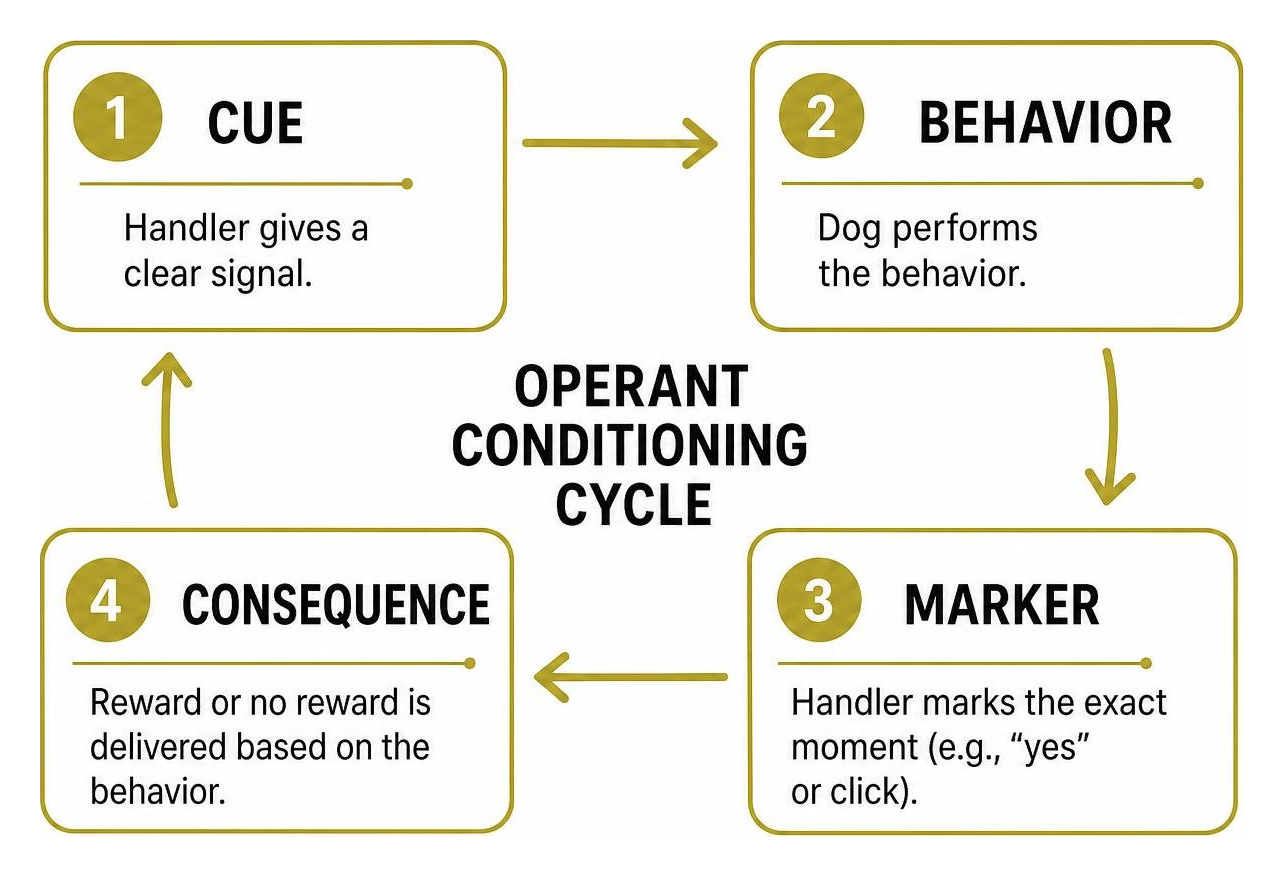
Timing is everything in this process. Dogs live in the immediate moment, requiring consequence markers within one to two seconds of an action. Motivation drives also vary based on personality. Food is generally a primary motivator, though toys, access to outdoor smells, and physical play tap directly into natural canine drives. Understanding clear boundaries, avoidance learning, and reward structures allows you to guide choices smoothly.
Essential Equipment and Setup for In Home Dog Training
Setting up your home environment correctly sets your dog up for success. Start training in low distraction environments like a quiet hallway, living room, or enclosed backyard before attempting public parks in Walnut Creek or Mill Valley.
Keep these core tools ready for your sessions:
- High value food rewards, such as diced chicken, liver treats, or small pieces of cheese
- A well fitted treat pouch worn on your waist for rapid reward delivery
- A six foot flat leash and a fifteen to thirty foot long line for distance practice
- Appropriate training leashes and fitted collars tailored to your dog’s physical needs
- Interactive tug toys or fetch balls for play motivated dogs
Structure your practice into short daily blocks. Attention drops sharply after ten minutes of continuous work, so two or three five minute micro sessions each day generate much better retention than one long, exhausting weekly drill.
Step by Step Fundamentals: Teaching Essential Obedience Cues

Mastering basic obedience establishes impulse control and reliable manners in everyday situations. Consistent verbal cues and clear hand signals allow your companion to process your instructions without confusion. When you show your dog exactly what you want, learning happens quickly and enthusiastically.
Mastering Basic Commands: Sit, Down, and Stay
Begin with lure and reward mechanics to build foundational positions.
- Sit: Hold a small treat at your dog’s nose level. Slowly lift the treat up and back over their head toward the spine. As their nose tilts up, their rear naturally touches the floor. The instant the bottom makes contact, speak your marker word and reward.
- Down: From a sitting position, bring a treat straight down between their front paws, then slowly drag it forward along the floor. As your dog follows the scent, their elbows will drop to the ground. Mark and reward immediately.
- Stay: Ask for a sit or down. Hold an open palm toward your dog’s face and wait two seconds. Mark and deliver a reward while they remain in place. Gradually increase the 3 Ds of training: Duration (time), Distance (steps away), and Distractions (movement around them). Always finish the cue with a clear terminal release word like “free” or “break” so your dog knows when the exercise is finished.
Developing Reliable Leash Manners and Recall
Walking politely on leash requires you to teach your dog that a loose leash creates forward motion, while pulling brings everything to an immediate stop. When your dog pulls ahead, halt immediately. Wait for them to look back or step toward you, mark the slack in the leash, and continue moving forward together. Practice frequent directional changes during walks in Alameda or Orinda to teach your companion to follow your movement.
For recall, use a long line in open spaces. Call your dog once in an upbeat tone, back away a few steps to encourage pursuit, and reward generously with high value food when they reach you. Never call your dog to end play or apply a bath, as that can poison the recall cue. If you want hands on practice alongside other neighborhood dogs, our structured group classes help polish leash manners and recall around realistic outdoor distractions. If you are located in the East Bay, our specialized dog training in Albany and Kensington programs offer targeted neighborhood support.
Overcoming Common Behavioral Challenges and Age Barriers

Behavioral modification requires identifying the underlying trigger driving an action, monitoring your dog’s arousal threshold, and maintaining consistent rules across the entire household.
Modifying Unwanted Behaviors: Jumping, Barking, and Pulling
Unwanted actions are often self rewarding habits that need clear boundaries and alternative outlets:
- Jumping on Guests: Dogs jump to initiate eye contact and greet at face level. Implement environmental management by keeping your dog on a leash when guests arrive at your San Francisco home. Ask for a calm sit before any greetings take place. If paws leave the floor, turn your back and step away until all four paws return to the ground.
- Excessive Barking: Address the root cause. For alert barking at windows, restrict visual access with opaque window film. For demand barking during dinner, ignore the noise completely and only reward calm silence. Combine this with ample physical exercise and mental enrichment like snuffle mats and puzzle toys.
- Leash Pulling: Consistently reward the heel position beside your leg. Pair directional turns with clear handling mechanics to turn your daily stroll into an engaging cooperative game.
Tailoring Dog Training to Breed Drives and Senior Dogs
Every breed group brings instinctual working drives that shape their training needs. Herding breeds require structured mental tasks, sporting dogs thrive on retrieve games, and hounds require dedicated scent work. Explore our educational articles for deeper breakdowns of behavioral mechanics across different working types.
It is never too late to train an older canine companion. While senior dogs may process new motor skills 20 to 30 percent slower than adolescent dogs, they frequently possess superior focus and fewer impulse control distractions. Keeping senior minds active through gentle obedience and problem solving games helps delay cognitive decline, keeping your older companion bright, engaged, and physically sound.
Training Timelines and When to Hire a Professional
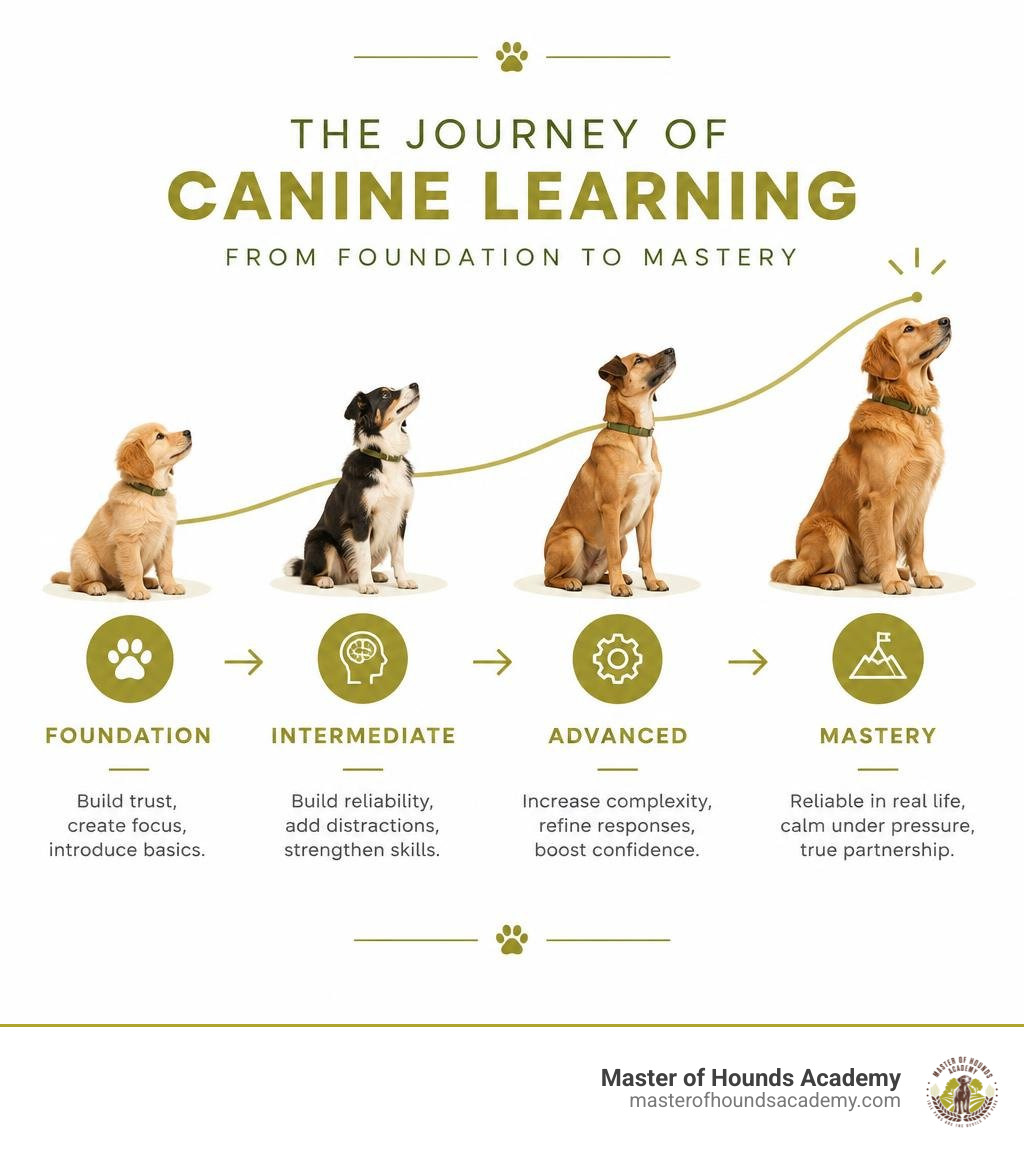
Building dependable manners is a cumulative journey that takes patience, consistency, and regular real world proofing.
Realistic Milestones and Training Schedules
Canine skills develop across predictable milestones when supported by 10 to 15 minute daily micro sessions:
- Weeks 2 to 4: Foundational obedience cues (sit, down, basic stay) become clear in low distraction home settings.
- Weeks 6 to 12: Leash walking mechanics improve, and impulse control becomes dependable around neighborhood distractions.
- Weeks 8 to 16: Reliable recall and off leash responsiveness solidify through systematic long line practice.
Choosing Between Group Classes, Private Lessons, and Boarding
While everyday house manners can be started at home, complex behavioral challenges like resource guarding, severe separation anxiety, or leash reactivity benefit greatly from professional expertise.
For customized guidance tailored to your home environment in Danville or Marin, our one on one private lessons provide personalized coaching for your family. If you prefer our team to handle the heavy lifting of behavioral transformation, our immersive board and train programs deliver focused, immersive development, lasting two weeks for puppies and four to six weeks for adult dogs.
Next Steps for Your Dog’s Training Journey
Achieving balance, clarity, and joyful obedience with your dog begins with a thoughtful, individualized plan. At Master of Hounds Academy, we are a family owned and operated business with over 30 years of hands on experience across the greater Bay Area. Founded by Francis Metcalf alongside Kylie Ghim, our training philosophy centers on the holistic Metcalf Method, crafting personalized, behavior based programs that adapt to your dog’s distinct personality.
Whether you reside in Oakland, Berkeley, El Cerrito, Concord, San Rafael, or Mill Valley, we are here to support your goals. Discover our comprehensive dog training services or schedule a free consultation today to start building clear communication and dependable manners with your dog.