
A Simple Framework for Effective Behavior Training
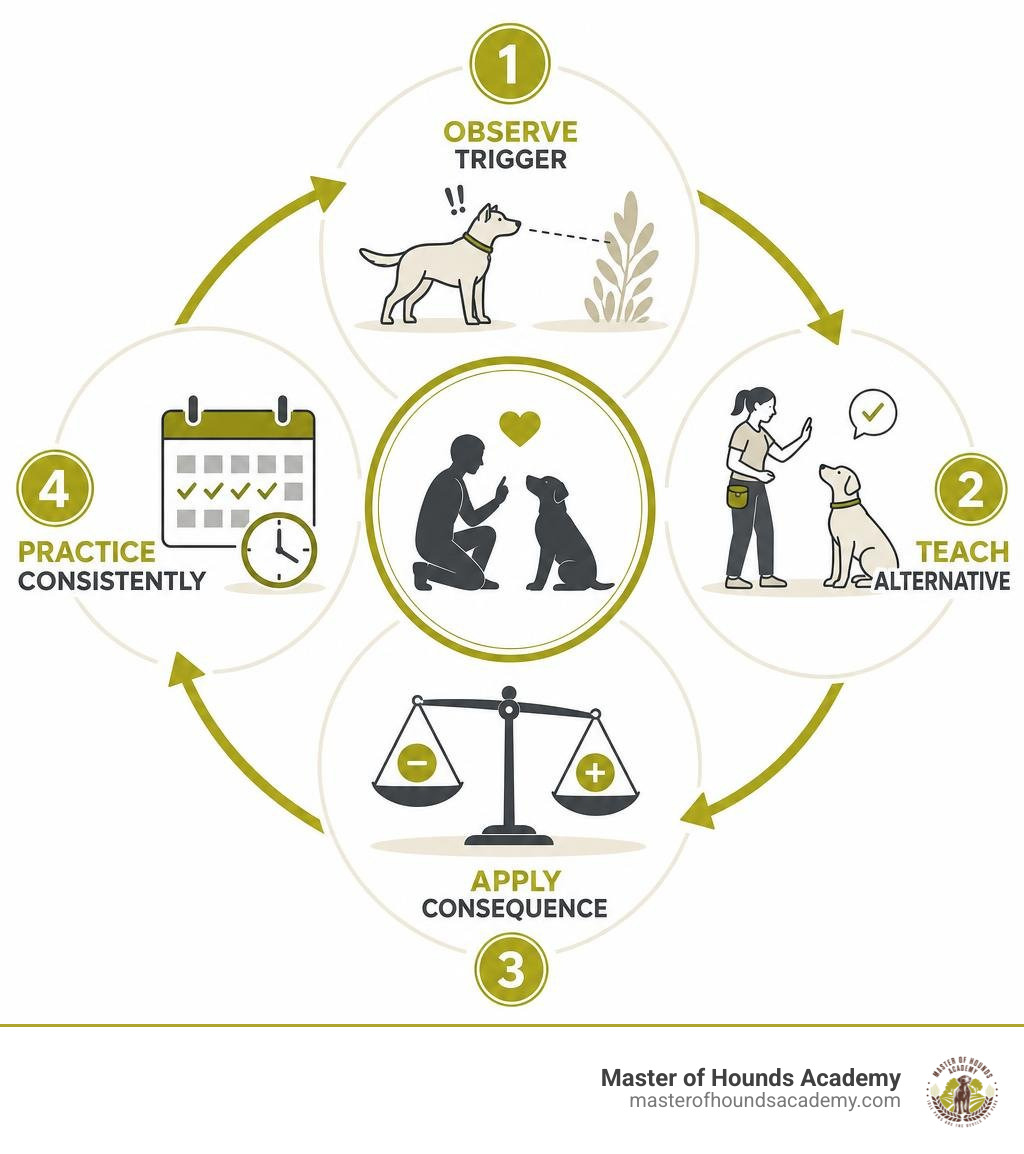
Behavior training works best when you identify what triggers a behavior, teach a clear alternative, and apply the same response every time. For a dog that jumps, pulls, barks, or becomes worried around distractions, start in an easier setting, reward the behavior you want, set fair boundaries, and raise the challenge in small steps.
The goal is not simply to stop an unwanted action. It is to help your dog understand what does work, whether that means walking beside you, settling on a mat, or looking to you when something exciting appears.
Good behavior modification also considers emotion. A fearful or overwhelmed dog cannot learn well when pushed too far, too fast. Calm repetition, thoughtful exposure to triggers, and clear communication build confidence that lasts beyond the training session.
I am Francis Metcalf, founder and co owner of Master of Hounds Academy. With more than three decades in dog behavior training, I have helped families build practical skills through personalized training, group classes, and board and train programs.
Fundamentals of Operant Learning and Behavior Training

Every creature navigates the world by assessing the outcomes of its choices. When a puppy sits and receives a savory bite of roast beef, that posture becomes a winning strategy. When a dog jumps against a boundary and encounters calm, purposeful guidance, the dog recalibrates. In our work across the San Francisco Bay Area, from the leafy streets of Berkeley and Lafayette to the hills of Mill Valley, we see that dogs thrive when their human partners communicate with complete clarity.
Behavior modification is the art and science of shaping those choices. To build genuine reliability, we look at the full picture of learning theory. Rather than guessing why a dog barks at the mail carrier or pulls toward another dog along the path in Orinda or Walnut Creek, we assess the antecedents, the exact actions, and the consequences that maintain them.
The Four Quadrants of Operant Conditioning
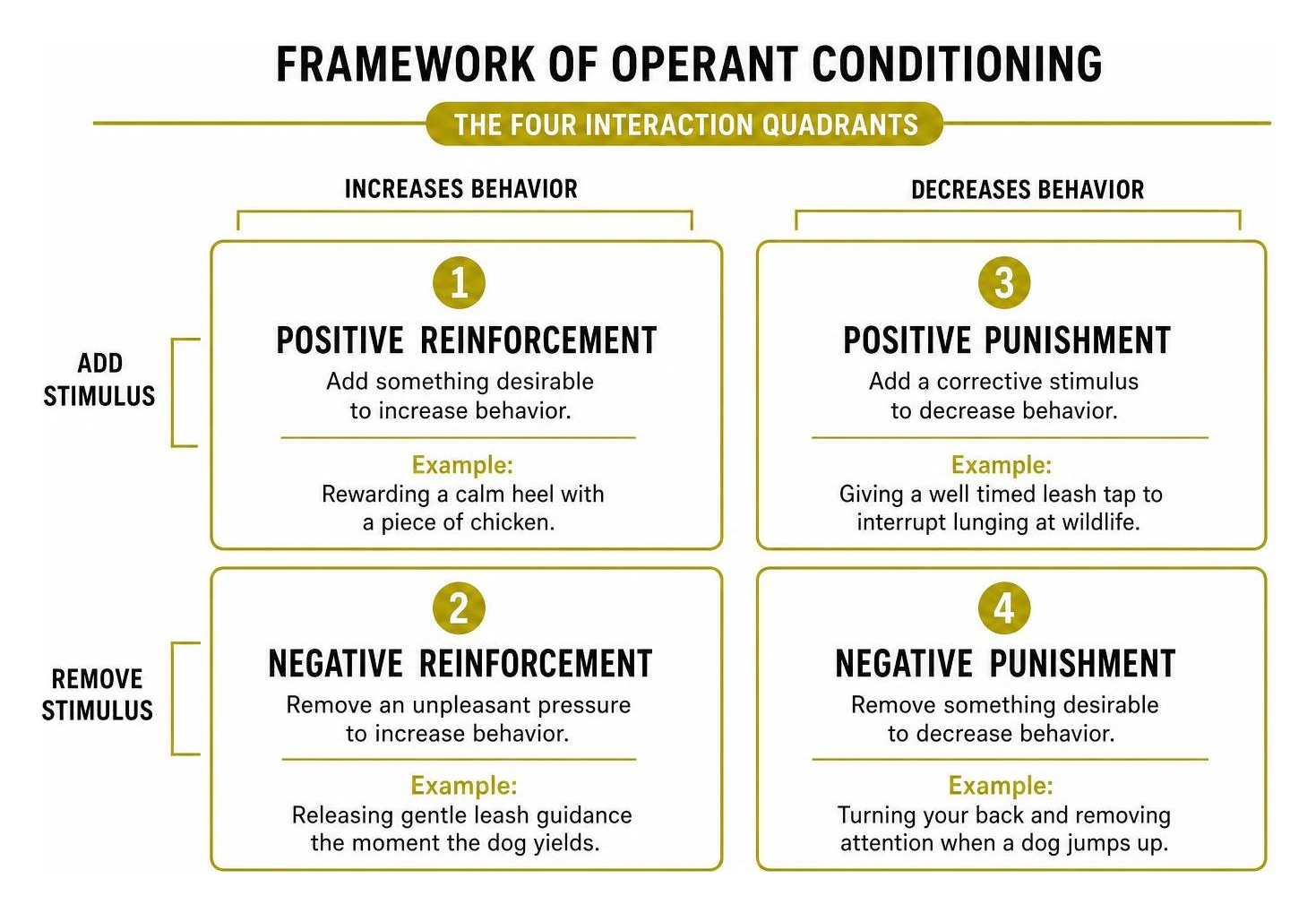
Operant learning functions through four distinct quadrants. Each quadrant represents a specific relationship between an action and an outcome. Balanced training uses the full spectrum of these four quadrants to give animals crystal clear feedback about what to do and what to avoid.
- Positive Reinforcement: Adding something desirable immediately following an action to increase the likelihood that the action happens again. For example, offering a high value reward the moment four paws touch the ground.
- Negative Reinforcement: Removing a mild pressure or physical prompt the instant the desired action occurs. A classic example is guiding a dog with gentle leash pressure and releasing that pressure the split second the dog yields and steps into position. The release teaches the dog how to find relief and comfort through cooperation.
- Positive Punishment: Adding a timely, fair correction or physical boundary to decrease an unwanted action. When delivered calmly and appropriately through specialized tools, it provides an unambiguous boundary that helps dogs make safer choices.
- Negative Punishment: Removing something the dog wants in order to reduce an undesirable action. Withholding attention, stepping away, or taking away access to a toy when a dog mouths too roughly are common examples.
To see how these principles create an intuitive balance during real world practice, explore our detailed overview of balanced dog behavior training to understand how each quadrant supports overall harmony.
| Operant Quadrant | Handler Action | Impact on Behavior Frequency | Everyday Example |
|---|---|---|---|
| Positive Reinforcement | Adds a pleasant stimulus | Increases behavior | Rewarding a calm heel with a piece of chicken |
| Negative Reinforcement | Removes an unpleasant pressure | Increases behavior | Releasing gentle leash guidance the moment the dog yields |
| Positive Punishment | Adds a corrective stimulus | Decreases behavior | Giving a well timed leash tap to interrupt lunging at wildlife |
| Negative Punishment | Removes a pleasant stimulus | Decreases behavior | Turning your back and removing attention when a dog jumps up |
Classical Conditioning vs Operant Conditioning
While operant conditioning deals with conscious actions and their results, classical conditioning deals with involuntary emotional reflexes. In the famous experiments conducted by Ivan Pavlov, dogs learned to salivate at the sound of a chime because the sound reliably predicted a meal.
Our dogs undergo this Pavlovian learning during every moment of their lives. If a dog hears the front door handle jiggle and immediately feels a surge of excitement or alarm, classical conditioning has taken place. The sight of a delivery van in Danville or a skateboard in San Francisco can trigger an involuntary physiological surge of adrenaline.
As outlined in the Merck Veterinary Manual guide on animal behavior, addressing deep rooted canine challenges requires working with both systems. Operant mechanics teach the physical movements we want to see, while classical conditioning reshapes how the dog feels about the surrounding environment.
Core Techniques for Lasting Behavioral Modification

Changing established habits requires a systematic approach. If a dog has spent three years barking out the living room window at passing neighbors in Alameda or El Cerrito, that habit will not vanish overnight. It requires structured exercises that reshape both emotional reflexes and physical choices.
Systematic Desensitization and Counterconditioning in Behavior Training
Systematic desensitization involves exposing an animal to an evocative trigger at such a low intensity that the animal notices it without becoming distressed. Counterconditioning changes the emotional meaning of that trigger by pairing it with an rewarding experience.
Consider a dog that reacts defensively toward other canines on walks. If we bring that dog within five feet of another dog, the emotional threshold is breached. The dog cannot process new learning because its system is flooded with stress hormones. Instead, we work at a generous distance, perhaps sixty feet away in a quiet corner of a park in Moraga or San Rafael.
At that comfortable distance, the dog sees the trigger, remains calm, and receives exceptional feedback and rewards. Over repeated sessions, the dog learns a new association. What once signaled danger now signals safety and reward. For families facing serious reactive hurdles, reviewing effective dog aggression solutions provides additional clarity on how to navigate complex emotional reactivity safely.
Shaping, Habituation, and Response Substitution
Beyond desensitization, we utilize several primary training tools:
- Shaping: Rewarding successive approximations toward a final target skill. Rather than expecting a complex task on day one, we reward the smallest initial step. If we want a dog to settle quietly in a travel crate, we first reward a glance at the crate, then a step toward it, then placing two paws inside, gradually building up to a relaxed rest.
- Habituation: The natural process by which an animal stops reacting to a harmless, repeated stimulus over time. Horses grazing in pastures next to busy highways gradually tune out traffic sounds. However, habituation only works if the stimulus is mild enough that it does not terrify the animal.
- Response Substitution: Teaching and heavily rewarding an incompatible alternative action. A dog cannot physically jump on your guests if it is engaged in a solid, stationary sit stay. By substituting the unwanted habit with an incompatible, well rehearsed task, we resolve the issue practically.
- The Premack Principle: Utilizing high probability desires to reinforce lower probability actions. In simple terms, a dog must perform a polite action before gaining access to something exciting. Requiring a calm eye contact check before unbuckling the car harness at the beach in San Francisco is a perfect application of this principle.
- Overlearning: Practicing a mastered skill well past the point of basic comprehension. Repeating a polite heel or recall under varied conditions makes the response automatic, ensuring it holds up even during moments of environmental stress.
Managing Environmental Triggers, Sensitization, and Clinical Support
Environmental management is the bedrock of successful modification. If an animal is allowed to rehearse an unwanted habit over and over, that neural pathway deepens. Management means setting up the living space and daily routines so the animal cannot practice the undesirable habit while training is underway. This might involve frosting a front window to block visual triggers, using white noise machines, or choosing calmer walking routes in Greenbrae or Concord.
Preventing Extinction Bursts and Sensitization
When we stop rewarding a habit that previously produced results, the brain does not instantly surrender. It tries harder first. This temporary spike in intensity or frequency is known as an extinction burst.
Imagine pressing a button on a vending machine. If your snack does not drop, you do not quietly walk away; you press the button five more times, harder and faster. A dog whose barking is suddenly met with total neutrality will often bark louder, faster, and longer for a few days. If the handler gives in during that burst, the dog learns that extreme persistence pays off. Consistency is vital to shepherd the dog through this temporary escalation.
Sensitization is the opposite of habituation. If a dog is repeatedly exposed to a scary trigger at full volume, such as forced exposure to loud fireworks or chaotic environments, the dog becomes more reactive rather than less. By recognizing understanding distinct dog personalities, handlers can tailor exposure levels to match the resilience and temperament of their individual pet.
The Role of Veterinary Support and Behavioral Medication
Some behavioral hurdles have deep physiological roots. When an animal lives in a state of chronic panic, its baseline neurological arousal prevents it from absorbing new lessons. In these instances, modern veterinary psychopharmacology can be a wonderful supportive bridge.
Prescription medications, such as selective serotonin reuptake inhibitors like fluoxetine or tricyclic antidepressants like clomipramine, work by normalizing neurochemical balance. These daily baseline medications do not alter a dog’s fundamental spirit or act as a standalone fix. Instead, they lower the emotional ceiling so that behavior modification can take root. Short acting situational medications may also be prescribed by your veterinarian for predictable acute stressors like severe storms or medical exams.
A complete medical evaluation is always the first step. Conditions like thyroid imbalances, chronic musculoskeletal discomfort, gastrointestinal distress, or dental pain can directly manifest as irritability, fear, or defensive behavior.
Professional Qualifications and Structuring Training Plans
Whether you are teaching basic family manners or working through complex rehabilitation, structured progression is essential. Young puppies in Albany or adult rescues in Marin benefit equally from systematic, predictable frameworks that set them up for lifelong success. Reviewing our guide on starting basic puppy training highlights how early clarity prevents behavioral regressions later in life.
Consulting reputable developmental resources like Puppy development and training research emphasizes the vital importance of the critical socialization window between seven and fourteen weeks of age. Introducing varied surfaces, sounds, people, and neutral animals during this window builds emotional resilience.
Structuring Effective Behavior Training for Lasting Results
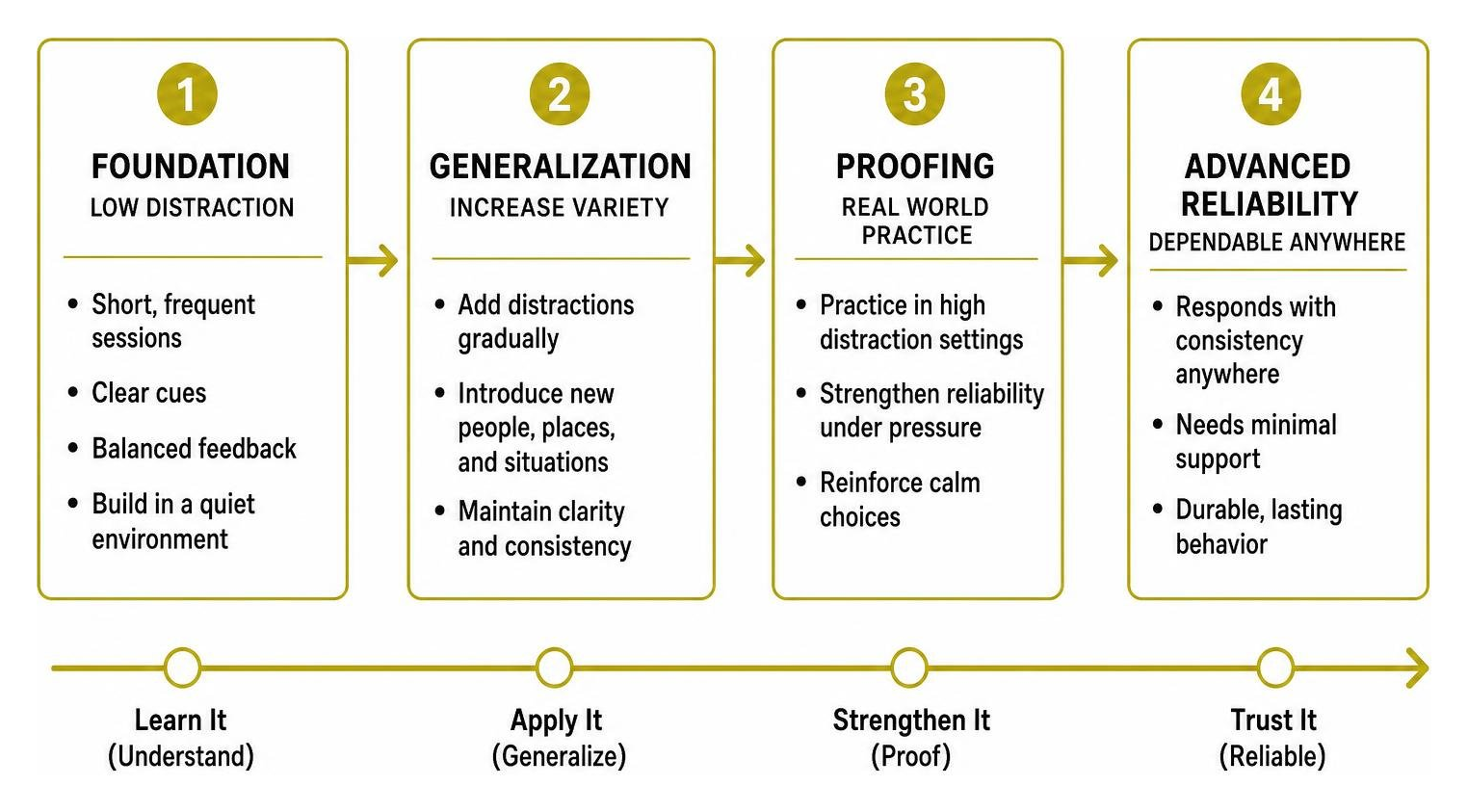
A well rounded behavior training plan breaks large goals into daily, manageable steps. Here is how we build long term success:
- Short, Frequent Sessions: Practice core skills in three to five minute intervals throughout the day rather than one exhausting hour on the weekend.
- Low Distraction Foundations: Teach new skills in a quiet living room before asking for the same skill in a bustling downtown district.
- Clear Environmental Cues: Use consistent verbal markers and distinct hand gestures so the dog never has to guess what is being asked.
- Balanced Feedback: Pair high value rewards for exceptional choices with clear, fair boundaries that guide the dog away from self rewarding misbehaviors.
- Fading Support: Once a movement is understood, fade out food lures quickly to ensure the dog responds to your direction rather than the sight of a treat in your hand.
Comparing Human Caregiver Frameworks and Canine Applications
Fascinating parallels exist between canine behavior modification and structured human caregiver programs, such as the Behavioral and Emotional Skills Training developed by the Child Mind Institute.
Human behavioral frameworks emphasize clear routines, positive recognition for cooperative actions, active ignoring of minor nuisance actions, and consistent, fair consequences for boundary crossing. In the human realm, professionals often undergo rigorous certification, such as completing a 40 hour Registered Behavior Technician curriculum aligned with Behavior Analyst Certification Board guidelines.
These shared principles remind us that across species, learning relies on structure, predictability, and emotional safety. When expectations are explicit and consequences are fair, anxiety drops and cooperation flourishes.
Frequently Asked Questions About Behavior Modification
How does negative reinforcement differ from positive punishment?
Negative reinforcement increases a desired action by removing a mild pressure the instant the animal performs the action. For instance, releasing gentle leash guidance when a dog steps into a heel position reinforces the heel. Positive punishment decreases an unwanted action by delivering a swift, fair correction when the dog commits an infraction. Both require precise timing and calm execution to remain fair and educational.
What causes an extinction burst during training?
An extinction burst occurs when an animal realizes that a previously successful strategy is no longer working. The brain temporarily escalates the frequency and intensity of the action to see if extra effort will produce the old reward. It is a completely normal stage of learning. Maintaining calm handling and refusing to reward the heightened outburst allows the behavior to fade away permanently.
When should medication be considered alongside behavioral modification?
Medication should be considered in partnership with your veterinarian when an animal’s fear, panic, or reactivity is so severe that it cannot remain below threshold during basic training setups. If an animal cannot take food, settle in its own home, or recover from everyday sights, medication helps bring brain chemistry into balance so cognitive learning can take place.
Creating Lasting Behavioral Harmony
Transforming behavior is a journey built on patience, technical clarity, and deep understanding of your companion. By combining thoughtful environmental management, desensitization, shaping, and balanced feedback across all learning quadrants, you can guide your dog toward calm confidence.
At Master of Hounds Academy, we bring over twenty years of experience to dogs and families throughout the East Bay, San Francisco, and Marin County. Our holistic Metcalf Method crafts personalized solutions that honor your dog’s unique personality while delivering reliable, real world results. To begin your journey, explore our comprehensive canine behavioral services and discover how balanced guidance can transform your life with your dog.