
Decoding the Mechanics: Operant Conditioning and the Four Quadrants
To make steady progress in basic puppy training, it helps to understand how young dogs make sense of their world. Dogs learn through the immediate outcomes of their actions. This process, known scientifically as operant conditioning, simply means that a puppy repeats actions that lead to good results and avoids actions that lead to unpleasant or unhelpful results.
When we look at learning theory, behavior is shaped using four distinct quadrants:
- Adding Desirable Rewards: Adding something the puppy likes (a treat, a toy, or affection) to make a behavior happen more often.
- Negative Reinforcement: Removing a mild pressure or discomfort the moment the puppy makes the desired choice, encouraging them to repeat that choice.
- Positive Punishment: Adding a timely boundary or correction to immediately decrease an unwanted behavior, such as jumping or biting.
- Negative Punishment: Removing something the puppy wants (such as taking away your attention when they jump) to show that the behavior stops the fun.
A balanced approach utilizes all four scientific quadrants of operant learning to give your dog a complete, fair education. Relying on a full spectrum of clear feedback ensures your puppy never has to guess what is expected. Using a marker word like “Yes” or a clicker pinpoints the exact millisecond your puppy completes a correct behavior, making communication crystal clear.
For additional context on canine learning mechanics, consult Puppy Behavior and Training Basics. Understanding how your dog learns will help you adapt your style to match their unique traits, which you can read more about in our Guide to Dog Personalities.
Core Foundations of Basic Puppy Training
Successful training depends far more on structure and handler clarity than on long, exhausting practice hours. Young puppies have brief attention spans. Expecting a 10 week old pup to focus for 30 minutes straight usually leads to frustration for everyone involved.
Keep formal training sessions to just 3 to 5 minutes at a time, repeated three to four times throughout the day. You can easily fit these micro sessions in right before mealtimes or after a potty break.

Training should begin the moment your puppy arrives home, typically around 8 weeks of age. Early focus should remain on building strong engagement, teaching your pup that paying attention to you brings wonderful outcomes. Control the environment by starting in a quiet room with minimal distractions. As your puppy masters skills indoors, you can slowly introduce new sights and sounds.
How to Build a Daily Basic Puppy Training Schedule
Puppies thrive when their days have a predictable rhythm. A reliable daily routine helps speed up potty training, reduces anxious behaviors, and ensures your pup gets enough sleep. Young dogs need anywhere from 16 to 20 hours of sleep per day for proper physical and brain development.
Here is how key developmental stages line up with house routine expectations:
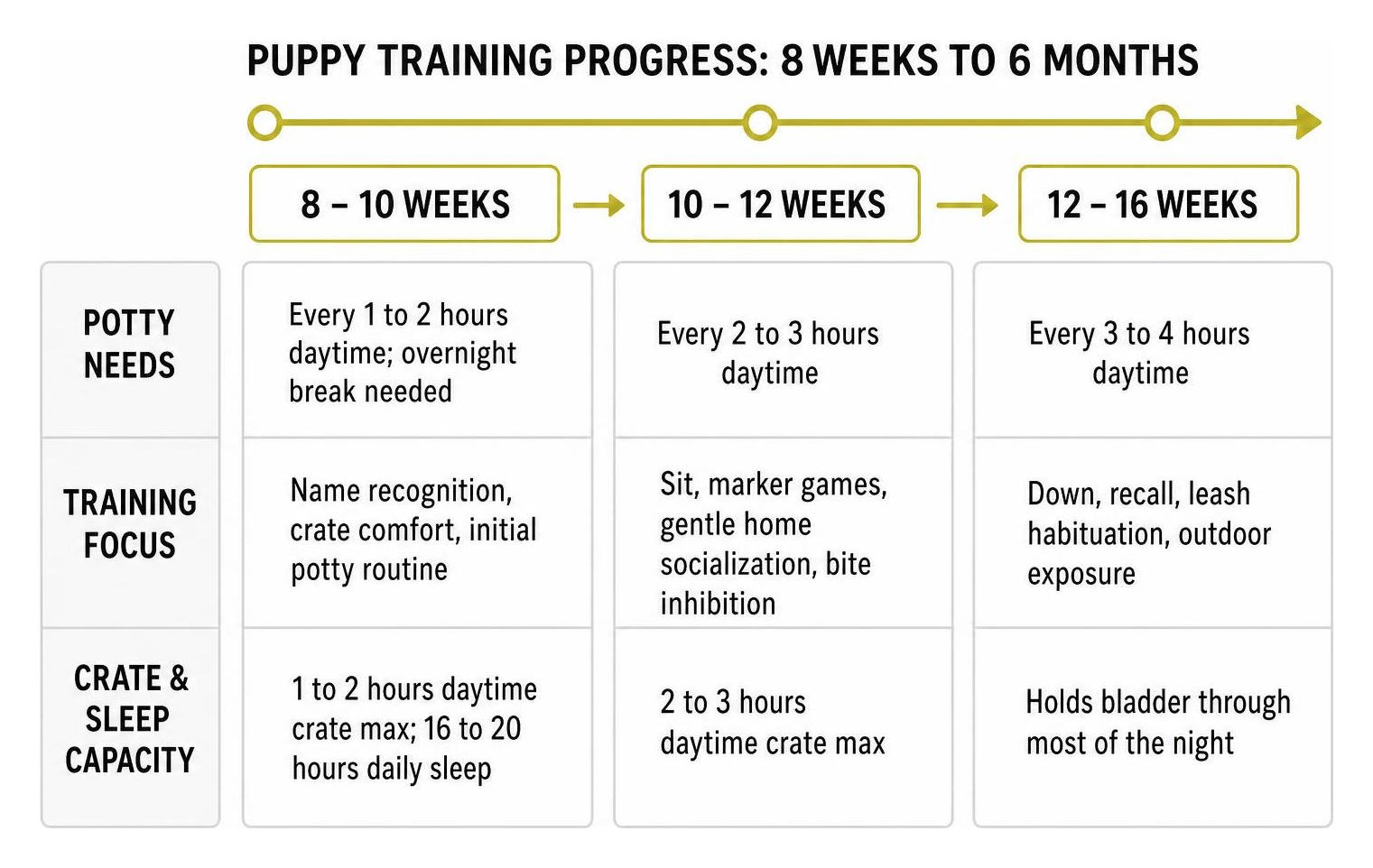
| Age Milestone | Potty Needs | Training Focus | Crate & Sleep Capacity |
|---|---|---|---|
| 8 to 10 Weeks | Every 1 to 2 hours daytime; overnight break needed | Name recognition, crate comfort, initial potty routine | 1 to 2 hours daytime crate max; 16 to 20 hours daily sleep |
| 10 to 12 Weeks | Every 2 to 3 hours daytime | Sit, marker games, gentle home socialization, bite inhibition | 2 to 3 hours daytime crate max |
| 12 to 16 Weeks | Every 3 to 4 hours daytime | Down, recall, leash habituation, outdoor exposure | Holds bladder through most of the night |
| 4 to 6 Months | Every 4 to 5 hours daytime | Stay, loose leash walking, impulse control, proofing cues | Can handle structured daily household routines smoothly |
To dive deeper into setting up a balanced home structure, check out this guide on an Age Appropriate Puppy Training Schedule.
Understanding the 3 3 3 Rule and 7 7 7 Socialization Rule
When bringing a new dog home, keep the 3 3 3 rule in mind:
- 3 Days: The puppy feels overwhelmed and needs time to decompress.
- 3 Weeks: The puppy begins adjusting to your daily household routine and shows more of their true personality.
- 3 Months: The puppy feels completely secure, safe, and settled in their home environment.
Along with giving your puppy time to settle, take advantage of the critical socialization window between 7 and 14 weeks of age. A useful framework for balanced exposure is the 7 7 7 rule. Before your puppy turns 4 months old, try to safely introduce them to:
- 7 different types of walking surfaces (carpet, tile, wood, grass, gravel, concrete, mulch).
- 7 different indoor and outdoor locations.
- 7 types of people (kids, adults, people with hats, umbrellas, or strollers).
- 7 different types of sounds (vacuum cleaners, doorbells, lawnmowers, traffic).
- 7 types of gentle handling (checking ears, touching paws, looking at teeth, brushing fur).
- 7 safe objects or novel items (cardboard boxes, ramps, low steps, rustling bags).
- 7 different types of containment or rest spots (various crates, pens, travel carriers, mats).
Essential Commands and How to Teach Them
Teaching basic cues requires a step by step approach. We guide the physical movement first, mark the correct action, reward it, and only add the verbal word once the physical movement is predictable.
The three primary physical ways to teach a new position are:
- Luring: Using a high value treat held right at the puppy’s nose as a magnet to guide their body into position.
- Capturing: Waiting for the puppy to offer a behavior naturally (like lying down on their own), then instantly marking and rewarding it.
- Shaping: Rewarding small incremental steps toward a final goal behavior (such as stepping toward a mat, then putting one paw on it, then sitting on it).
Step by Step Basic Puppy Training Cues
Here is how to teach the foundational cues every dog should know.
Sit
- Hold a small treat right at your puppy’s nose.
- Slowly move the treat back over their head toward their spine.
- As their head tilts up to follow the treat, their bottom will naturally touch the floor.
- The moment their rear touches the ground, mark with “Yes!” and deliver the reward.
- Once they follow the hand motion smoothly, say the word “Sit” right as they begin to lower down.
Down
- Start with your puppy in a sitting position.
- Hold a treat near their nose and draw a line straight down to the floor between their front paws.
- Slowly pull the treat along the floor away from them in an “L” shape.
- As their elbows touch the floor, mark “Yes!” and hand over the reward.
Recall (Come)
- Step back a few paces from your puppy in an enclosed, quiet area.
- Crouching down, call their name followed by “Come!” in an upbeat tone.
- As they run toward you, mark “Yes!” the moment they reach your feet, then offer praise and a reward.
- Keep recall practice fun and positive so your pup always enjoys returning to your side.

Stay
- Ask your puppy to “Sit” or “Down”.
- Open your hand flat like a stop sign in front of their face and say “Stay”.
- Pause for just two seconds. If they hold position, mark “Yes!” and reward.
- Teach a clear release word such as “Free” or “OK” to let them know the posture is complete.
- Slowly increase duration, then distance, and finally distractions.
For more helpful details on mastering these foundational movements, read Teach Your Puppy These 5 Basic Cues.
Fading Food Rewards and Building Reliability
Food lures are wonderful training wheels, but you do not want to carry treats in your pocket forever. Lures should fade quickly, often within 5 to 10 repetitions.
To fade a lure, hold your hand in the exact same shape but keep it empty. Guide your pup using the empty hand gesture. When they complete the movement, mark “Yes!” and fetch a treat from your pouch or table with your other hand. Your hand gesture naturally turns into a discrete hand signal.
Once a cue is understood, move from rewarding every single attempt to a variable ratio schedule. Reward the best efforts with food, and reward other good responses with verbal praise, belly rubs, or a game of tug. Clear boundaries and consistent feedback ensure your puppy responds reliably even when food is not present.
Managing Daily Behaviors: Housebreaking, Biting, and Socialization
Training does not happen in a vacuum. Managing day to day puppy habits like potty training, mouthing, and chewing is just as critical as teaching structured obedience cues.

- Housebreaking: Take your puppy outside on a set routine after every nap, meal, drink, and play session. Accompany them outside, wait quietly, and reward them the moment they finish eliminating.
- Crate Comfort: Make the crate an inviting den. Feed meals inside the crate and drop safe stuffed chew toys in with them for brief, calm resting periods throughout the day.
- Bite Inhibition: Puppies explore the world with their teeth. When your puppy nips too hard, voice a clear, sharp “Ouch” or immediate verbal boundary, pause the game, and redirect their mouth onto an appropriate chew toy. Evening biting episodes usually signal an overtired puppy that needs an enforced crate nap.
- Safe Socialization: You do not need to wait until every vaccine round is complete to socialize your dog safely. Carry your puppy through public areas, visit friend’s clean yards, or set up controlled playdates with known healthy dogs.
For a complete week by week breakdown on balancing home management with obedience goals, explore Puppy Training 101: A Week by Week Guide.
Common Pitfalls and How to Transition to Life Long Obedience
Even dedicated owners encounter occasional bumps in the road. Watch out for these common training pitfalls:
- Inconsistent Cues: Saying “Down” when you mean “Off the couch” confuses your puppy. Make sure every family member uses identical cue words.
- Delayed Consequences: Giving feedback ten seconds after a behavior happens is ineffective. Puppies connect feedback only with what they are doing at that exact moment.
- Over Graining Sessions: Practicing for too long wears out a young dog’s brain. Stop while your puppy is still enthusiastic and winning.
- Jumping to High Distraction Environments: Expecting a puppy to sit in a busy park before they can sit reliably in your kitchen sets them up for failure. Gradually increase distraction levels.
Group puppy classes offer a fantastic way to practice cues around controlled real world distractions. Professional instruction ensures you receive personalized coaching to address your puppy’s unique temperament and keep your home on track for life long obedience.
Frequently Asked Questions About Basic Puppy Training
What basic commands should I teach a 3 month old puppy first?
Focus first on name recognition, sit, down, come when called, and a reliable drop or leave it command. Alongside these physical position cues, prioritize potty routines, crate comfort, and gentle bite inhibition.
How long should puppy training sessions be each day?
Structured training sessions should be brief, lasting between 3 and 5 minutes at a time. Repeating these micro sessions three to four times a day offers plenty of practice without overwhelming your puppy’s attention span.
How do I stop my puppy from biting and chewing furniture?
Provide plenty of safe, textured chew toys and keep household items safely out of reach. If your puppy targets furniture or hands, deliver a prompt verbal correction or immediate redirect, replace the item with a chew toy, and praise them when they bite the toy. Persistent evening chewing often means your puppy is overtired and needs a quiet nap in their crate.
A Balanced Path Forward for You and Your Dog
Raising a puppy is an exciting journey full of growth, discovery, and plenty of playful energy. By applying balanced training principles, setting up a solid routine, and communicating clearly from day one, you are laying the groundwork for a calm, trustworthy adult dog. Every quiet moment, every brief training game, and every shared adventure builds a stronger bond between you and your companion.
If you are looking for expert guidance tailored specifically to your family dynamic and your dog’s unique personality, our team is here to help. Explore our full range of behavior based training programs on the Master of Hounds Academy Services page, and let us help you transform your puppy into the perfect companion for life.