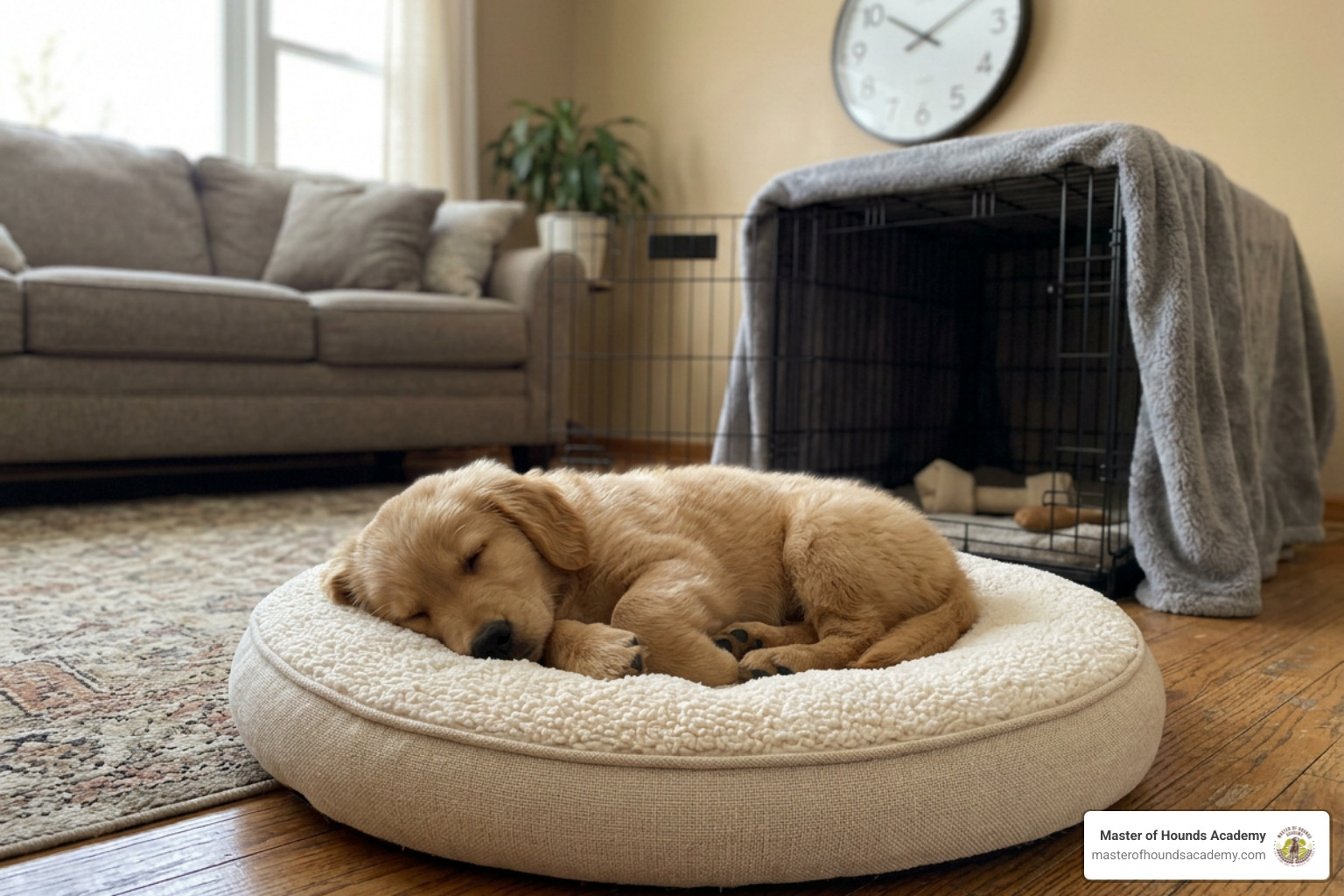

A Simple 8 Week Puppy Sleep Schedule for Your First Days Home
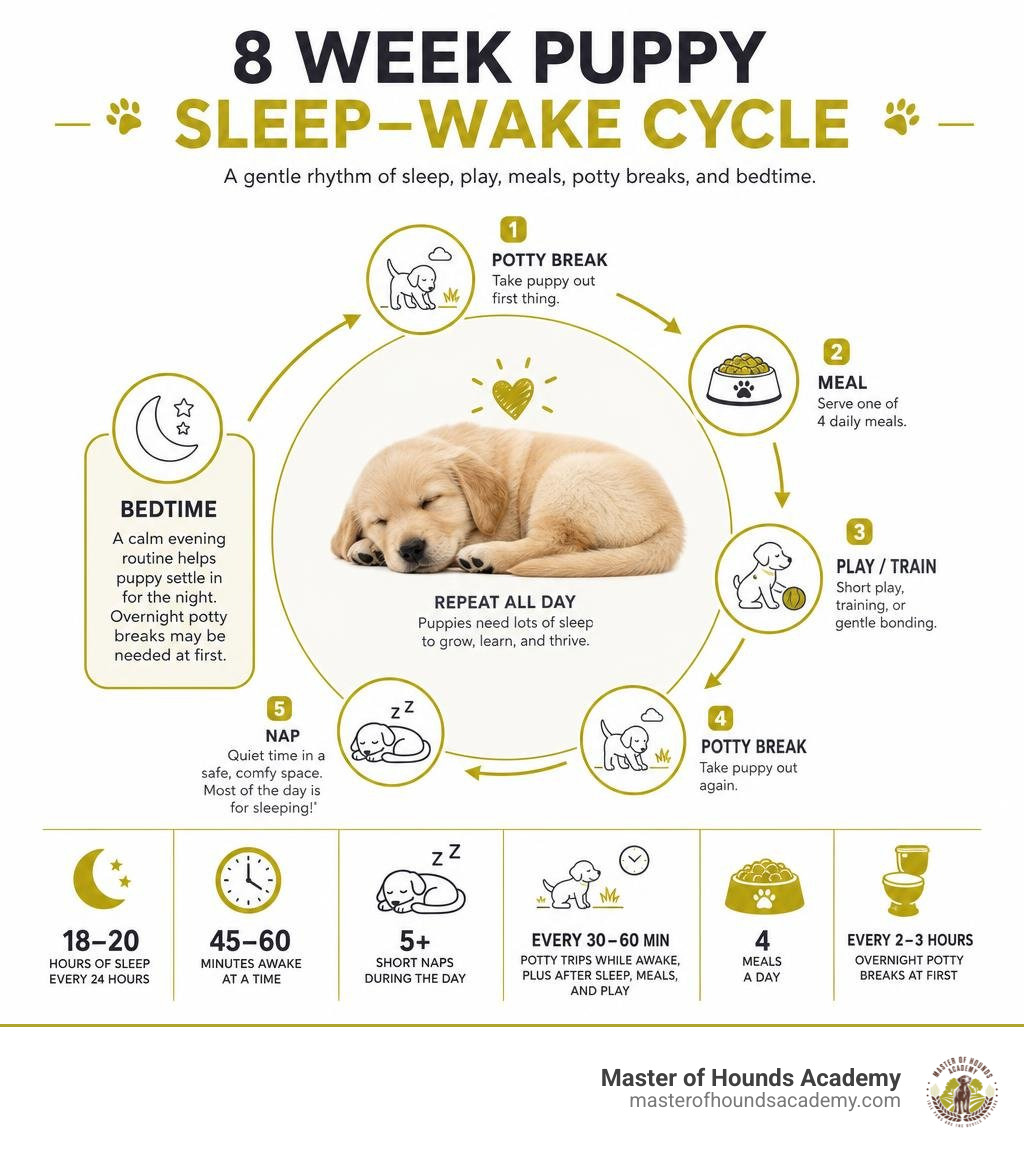
A 8 week puppy sleep schedule is less about a perfect clock and more about a gentle repeatable rhythm: potty, meal, short play or training, potty again, then sleep. At this age, most puppies need 18 to 20 hours of sleep every 24 hours and can usually stay awake for only 45 to 60 minutes before they need another nap.
| Quick guide | What to expect at 8 weeks |
|---|---|
| Total daily sleep | 18 to 20 hours |
| Awake window | 45 to 60 minutes, often less |
| Daytime naps | About 5 or more short naps |
| Potty trips while awake | Every 30 to 60 minutes, plus after sleep, meals, and play |
| Meals | Usually 4 meals a day |
| Overnight potty breaks | Often every 2 to 3 hours at first |
Your new puppy has just left littermates, familiar smells, and a life built around sleeping in a warm puppy pile. A calm routine gives them a clear map of the day, while helping your household keep its footing through the joyful little whirlwind.
I am Francis Metcalf, founder and co owner of Master of Hounds Academy, and I have spent more than two decades helping families build practical routines for young dogs. In this guide, I will show you how an 8 week puppy sleep schedule can support better rest, cleaner potty habits, and a calmer start at home.
The Biology Behind an 8 Week Puppy Sleep Schedule
Understanding why an 8 week old puppy sleeps so much requires a quick peek into their biology. When you bring your new companion home to Berkeley or Oakland, you are holding a baby whose brain and body are working at maximum capacity. Sleep architecture in young dogs is intense, restorative, and absolutely nonnegotiable.
Proper daily structure anchors your home life, as highlighted in this guide on 8 Week Puppy Schedule – A Realistic Daily Routine For New Owners. When we establish predictable expectations, we lay down the physical and behavioral bedrock for a balanced dog.
Daily Sleep Requirements and Biological Development
An 8 week puppy requires roughly 18 to 20 hours of sleep out of every 24 hour cycle. During these extensive nap stretches, several critical biological processes occur:
- Physical growth and tissue repair: Growth hormone releases primarily during deep sleep cycles, rebuilding muscle tissue and extending bone structure.
- Neural construction: Millions of new synaptic connections form each day as your pup explores the living room rug or smells the fresh air in your backyard.
- Memory consolidation: Sleep processes the short training interactions, environmental social cues, and household boundaries learned during awake periods.
Without adequate rest, your pup cannot process their world effectively. Sleep deprivation undermines physical immunity and emotional resilience, turning an eager learner into a stressed, easily overwhelmed baby.
Understanding Awake Windows vs. Clock Hours in an 8 Week Puppy Sleep Schedule
Many new owners make the mistake of watching the wall clock rather than watching their puppy. At 8 weeks old, an awake window usually lasts between 45 and 60 minutes. For many sensitive or energetic pups, 40 minutes is the actual limit before overstimulation sets in.
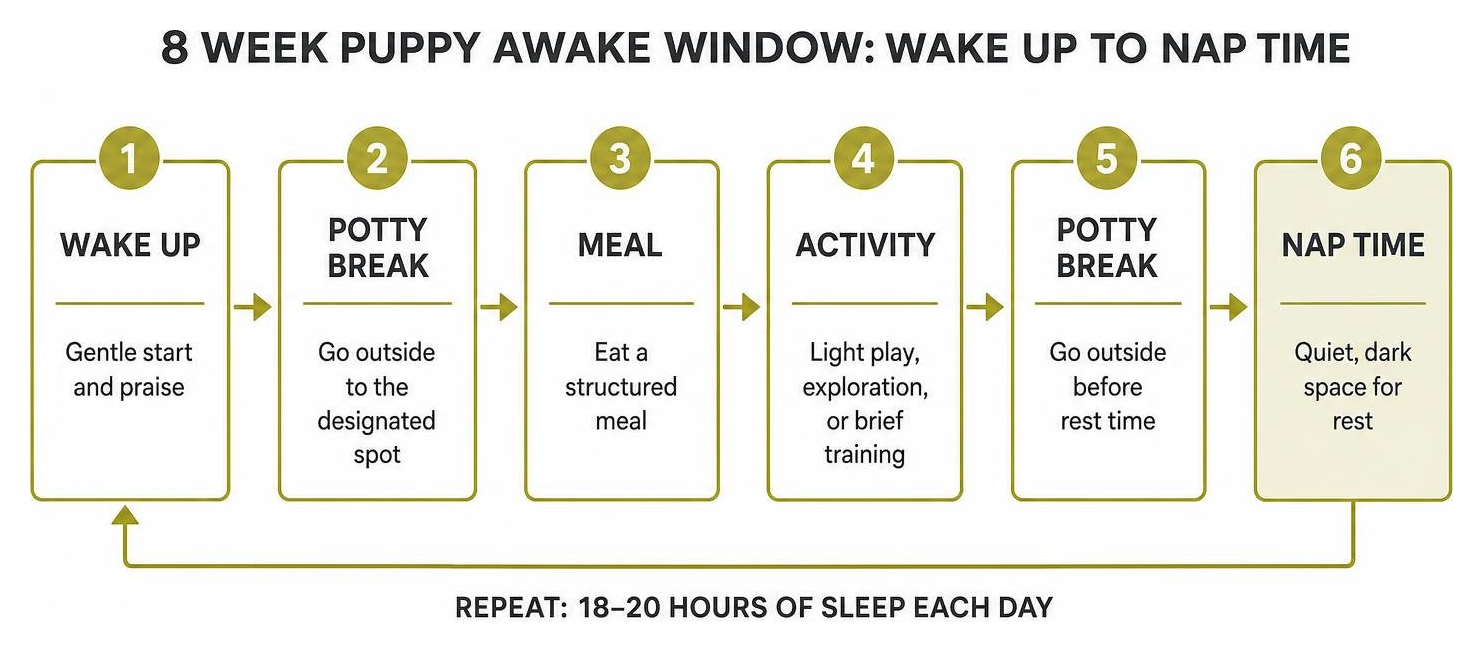
When you look at an 8 week puppy sleep schedule, think in terms of biological event sequences rather than exact clock minutes:
- Wake up and go straight to the designated outdoor toilet spot.
- Eat a structured meal or engage in a quick microtraining session.
- Enjoy light play, household exploration, or gentle socialization.
- Take a quick final potty break outdoors.
- Settle into the crate for rest.
If you push past that 60 minute ceiling, your puppy does not get a helpful second wind. Instead, they flood with stress hormones like cortisol, making quiet sleep significantly harder to achieve.
Realistic Hour by Hour Routine and the 1 Hour Up Rule
Creating household predictability in San Francisco or Marin means building a calm rhythm that works for human work routines and puppy biological limits alike. The core engine of early daily management is the famous 1 hour up and 2 hours down concept.

Using operant learning principles across all four scientific quadrants, we give puppies clear, fair feedback about their choices. Structured routines remove confusion, showing your dog exactly when it is time to work, when it is time to play, and when it is time to rest.
The 1 Hour Up, 2 Hours Down Framework at 8 Weeks
The 1 hour up rule should be viewed as a biological ceiling, not a required target. If your 8 week puppy plays for 35 minutes and starts mouthing your shoes or wandering aimlessly, their awake window is already closing.
When your puppy finishes eating, the gastrocolic reflex triggers bowel motility within 10 to 20 minutes. Therefore, your sequence during that single hour awake must tightly align potty trips with feeding and sleeping.
Hour by Hour Breakdown of an 8 Week Puppy Sleep Schedule
Here is a practical, tested sample timetable for an 8 week old puppy. You can read more about structured progression in this detailed breakdown of a Puppy Nap Schedule at 8 Weeks: An Hour by Hour Plan for 8, 9, and 10 Week Olds | Pawpy Blog.
| Time Block | Activity Focus | Routine Details |
|---|---|---|
| 6:00 AM to 7:00 AM | Morning Start | Outdoor potty immediately, Breakfast Meal 1, quick 5 minute leash lesson, potty trip, crate nap |
| 7:00 AM to 9:00 AM | Nap 1 | Enforced crate rest in a dark, quiet room |
| 9:00 AM to 10:00 AM | Mid Morning Block | Potty break, light indoor play, gentle handling practice, potty break, nap |
| 10:00 AM to 12:00 PM | Nap 2 | Enforced crate rest |
| 12:00 PM to 1:00 PM | Midday Block | Potty break, Lunch Meal 2, microtraining with kibble rewards, potty break, nap |
| 1:00 PM to 3:00 PM | Nap 3 | Enforced crate rest |
| 3:00 PM to 4:00 PM | Afternoon Block | Potty break, quiet chew toy engagement, light yard exploration, potty break, nap |
| 4:00 PM to 5:30 PM | Nap 4 | Enforced crate rest |
| 5:30 PM to 6:30 PM | Evening Block | Potty break, Dinner Meal 3, family interaction, final play window, potty break, nap |
| 6:30 PM to 8:00 PM | Nap 5 | Enforced crate rest (Critical nap to prevent late night meltdowns) |
| 8:00 PM to 9:00 PM | Wind Down Block | Potty break, Light Meal 4 or snack stuffed toy, quiet couch snuggles, final evening potty trip |
| 9:00 PM | Bedtime | Crate entry for overnight sleep block |
Overtiredness vs. Hyperactivity: Spotting the Signals
One of the most common issues we address with clients in Alameda and Walnut Creek is misinterpreting an overtired puppy as a dog that needs more exercise. When a puppy stays awake too long, their body produces adrenaline to stay operational. This looks like chaotic energy, but it is actually exhaustion.
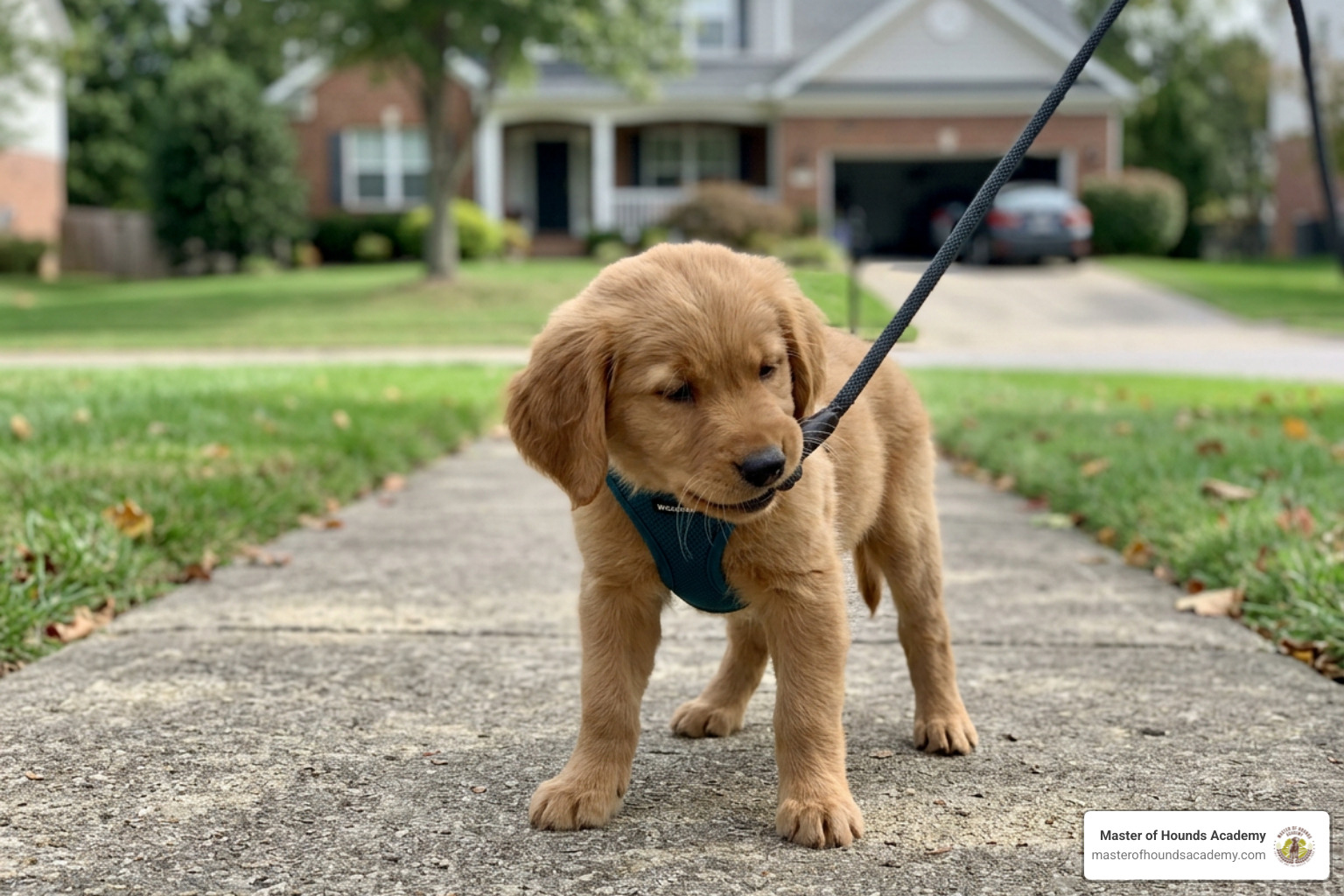
Understanding behavioral cues keeps you from accidentally overstimulating a baby who desperately needs sleep. You can review additional setup advice in this resource on How to Set Up an 8 Week Old Puppy Training Schedule by Age & Routine.
Behavioral Tells: Crocodile Nipping, Zoomies, and Deafness
When an 8 week puppy crosses from pleasantly tired to overtired, their behavior shifts predictably:
- Hard crocodile nipping: Bites lose their soft feedback and become grabby, frantic, and persistent on skin or clothing hems.
- Selective hearing and loss of focus: The puppy suddenly acts as if they have forgotten their name or simple guidance cues they knew earlier in the day.
- Frantic zoomies: High speed, unfocused running, barking, or tearing through house corridors without intent.
- Destructive mouthiness: Sudden intense chewing on table legs, electrical cords, carpet corners, or rug tassels.
If your pup displays these behaviors after 45 minutes of awake time, do not offer another toy or play session. They are telling you their nervous system has overheated.
Enforced Naps: Restoring Emotional Balance
Enforced naps are not a punishment; they are a vital health tool. Place your puppy calmly into their crate with a clear cue, a chew item, and a quiet environment.
By providing structured resting spaces, you teach your dog impulse control and emotional self regulation. Balanced training relies on giving clear boundaries alongside quiet rest, allowing your puppy to reset their physiological balance every few hours.
Creating the Ideal Nighttime Routine & Crate Setup
A successful night begins long before you turn off the lights. Designing a clear wind down routine transforms chaotic bedtimes into predictable, peaceful sleep blocks. For step by step ideas, explore this guide on a puppy sleep schedule first week at home: Complete Guide.
Nighttime Potty Schedule and Handling Middle of the Night Crying
An 8 week old puppy has limited physical bladder capacity. While awake, they need to eliminate frequently; while sleeping peacefully, they can typically hold their bladder for 2 to 3 hours maximum.
When managing overnight potty trips, keep interactions strictly transactional:
- When the alarm goes off or your puppy whimpers after a rest stretch, carry them quietly to the potty area.
- Keep lights low and refrain from excited vocal tones or play interactions.
- Allow up to 3 minutes for elimination, offer calm verbal confirmation, and carry them directly back to the crate.
If your puppy whines in the crate solely for attention, employ the three second silence rule. Wait until your puppy pauses their vocalization and stays silent for at least three seconds before opening the crate door or stepping into view. This ensures you reinforce calm behavior rather than demand barking.
Crafting a Safe, Distraction Free Sleep Environment
Setting up the physical sleep space requires thoughtful attention to sensory details:
- Proper crate sizing: The crate should offer enough room for the pup to stand, turn completely around, and lie flat, but not enough room to eliminate in one corner and sleep in another.
- Temperature regulation: Puppies under 12 weeks struggle with body temperature control. Keep the room between 70 and 75 degrees Fahrenheit, away from drafts or direct heater vents.
- Ambient sound: Use a box fan or white noise machine to mask urban sounds, street traffic, or household movement.
- Scent comfort: Place a soft fleece blanket or an unwashed garment you have worn inside the crate to provide reassuring family scent cues.
For additional insight into setting effective bedtime habits, read What Is a Good Bedtime for an 8 Week Old Puppy? as well as veterinary strategies outlined in Puppy Sleep Schedule: Perfect Routine for Better Rest.
Navigating the First Week and Long Term Schedule Transitions
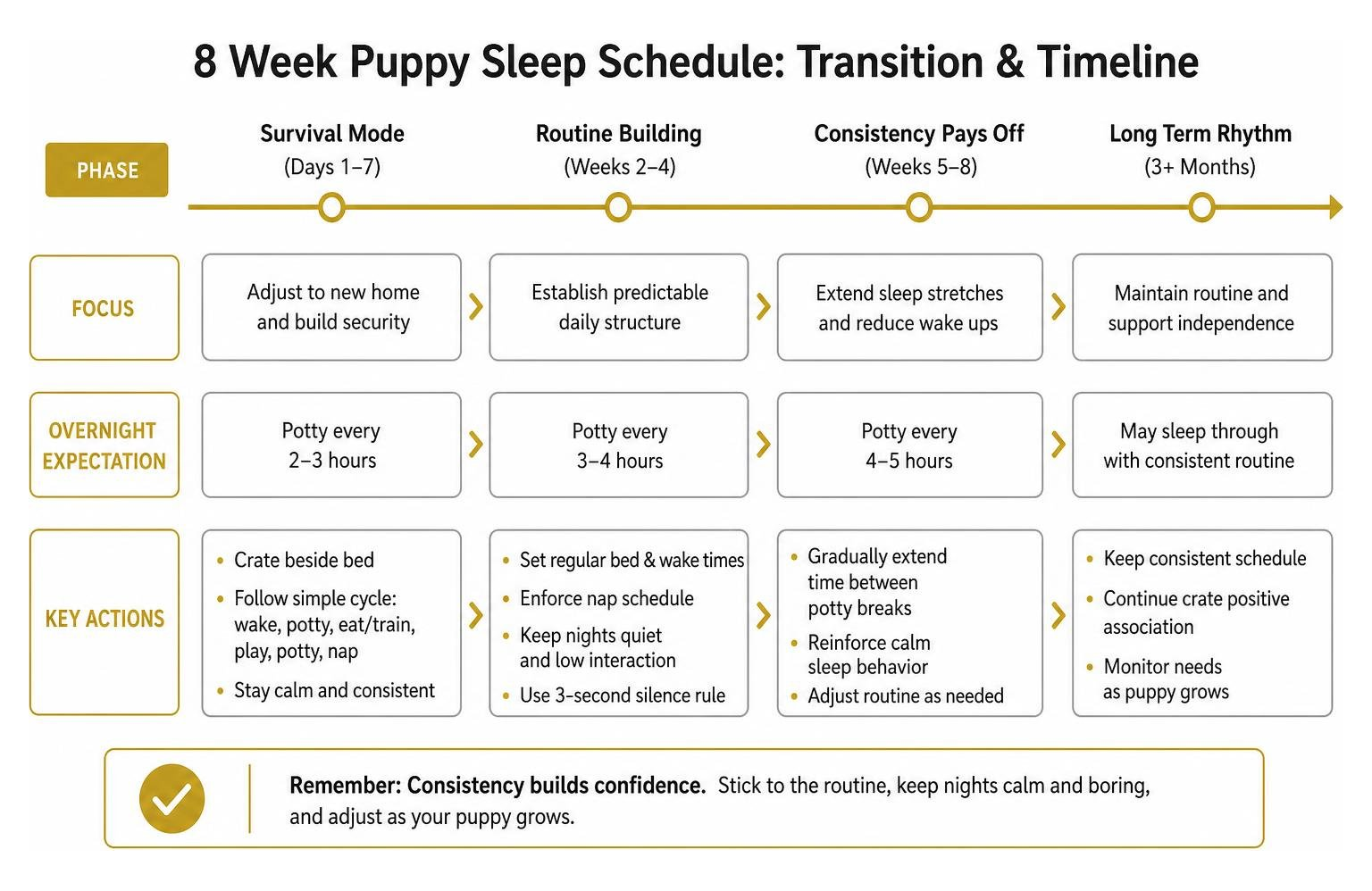
The first week with your 8 week puppy is about establishing a predictable structure while acknowledging that early days can feel chaotic. Expecting total perfection on day two leads to unnecessary frustration. Focus on the sequence of events, and the timing will naturally settle into place.
Survival Mode: Days 1 to 7 at Home
During the first several days in your household, your puppy is adjusting to the loss of littermate contact. Place the crate right beside your bed so they can smell your presence and hear your breathing.
If your puppy whines initially, place a hand calmly near the crate bars without turning the moment into a game. Focus on repeating the simple sequence: wake up, toilet, food or training, play, toilet, nap. Repeating this framework builds habituation quickly across their first week.
Transitioning Schedules as Your Puppy Grows
As your dog moves from 8 weeks to 10 and 12 weeks of age, their biological needs shift:
- Expanding bladder control: Overnight continuous sleep blocks stretch from 3 hours up to 5 or 6 hours.
- Consolidating daytime naps: Daytime rest shifts from 5 or 6 scattered short naps down to 3 or 4 longer rest periods.
- Extended awake windows: Awake capacity expands from 45 minutes to 75 or 90 minutes of active learning and engagement.
By staying tuned to these developmental markers, you can adjust your household routine smoothly while keeping your dog balanced and confident.
Frequently Asked Questions About Puppy Sleep Schedules
How do I know if my puppy is getting enough sleep?
A well rested 8 week puppy wakes up bright, curious, and eager to interact. During awake windows, they display clean focus during microtraining, move with coordinated physical energy, maintain a healthy appetite, and settle comfortably into naps without endless frantic whining.
Should I wake my 8 week old puppy up to go potty at night?
Setting proactive alarms for night potty trips during the first week prevents your puppy from having to scream or panic to empty their bladder. Setting two alarms, such as 1:30 AM and 4:00 AM, allows you to take your pup out calmly before an accident or high distress occurs, keeping nighttime routines smooth and quiet.
What should I do if my puppy wakes up crying at 2 AM?
First, evaluate if it has been 2 to 3 hours since their last trip outside; if so, assume a physical need to eliminate. Carry them out quietly for a transactional potty break. If they have just gone out and are simply testing boundaries, stay quiet and wait for a pause in vocalization using the three second silence rule before addressing them.
Building Lasting Harmony with Your Puppy
Establishing an 8 week puppy sleep schedule creates a serene rhythm for your home and gives your young dog the best possible foundation for physical health and cognitive growth. By balancing quiet rest, clear boundaries, and structured daily engagement, you guide your pup toward emotional stability and wonderful lifelong habits.
Every puppy brings a unique personality to the table. If you want personalized hands on guidance to perfect your dog routines, housebreaking, or foundational manners across the Bay Area, explore our tailored private lessons for puppy behavior. At Master of Hounds Academy, we look forward to helping you build a joyous, well balanced relationship with your dog!