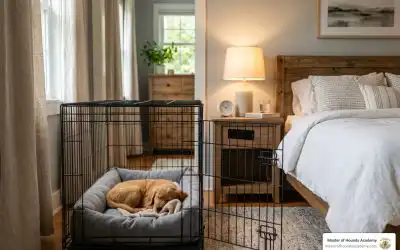

How to Master In Home Puppy Training for a Well Behaved Companion
To succeed with in home puppy training, follow these essential daily steps:
- Establish a strict routine: Schedule potty breaks every two hours, set regular meal times, and enforce quiet crate naps.
- Set up indoor management: Use pens, crates, and baby gates to prevent household accidents and destructive chewing before they start.
- Teach foundational markers: Introduce clear verbal markers and food rewards to shape basic cues like sit, down, and place on your actual home floors.
- Channel puppy energy: Immediately redirect biting and nipping toward approved chew toys and structured tug games.
- Practice real world manners: Use a lightweight indoor leash to guide your puppy through polite greetings at the front door and calm behavior around the dinner table.
Training inside your living space gives your dog the context they need to thrive. When your puppy learns how to settle in your living room and ignore kitchen distractions, those good manners quickly become lifelong habits.
I am Francis Metcalf, founder of Master of Hounds Academy, where our team brings over thirty years of combined experience using our balanced Metcalf Method to guide families through in home puppy training. In this guide, I will walk you through the practical steps to raise a calm, reliable companion who fits smoothly into your everyday life.
Key in home puppy training vocabulary:
The Core Benefits of In-Home Puppy Training
Bringing a brand new puppy into your residence is an exhilarating milestone, whether you are bustling through a lively morning in San Francisco, unwinding in quiet Orinda, or raising kids in Danville. Yet, the initial weeks often bring a whirlwind of chewed shoes, broken sleep, and unexpected puddles on hardwood floors. This is precisely why private instruction within your own living space offers an unmatched advantage.
When we teach puppies inside the exact environment where they eat, sleep, and play, learning happens in real time without confusing contextual gaps. Puppies are notoriously specific learners. A young dog might perform a flawless sit inside a sterile classroom or warehouse, only to turn completely wild the moment they hear your front doorbell ring or catch the scent of dinner on your kitchen island. In house instruction addresses everyday triggers immediately.
Working directly in your residence allows us to:
- Identify specific household danger zones and implement practical management boundaries.
- Teach everyone in the home, from young children to visiting grandparents, how to give clear, harmonious cues.
- Use all four scientific quadrants of operant learning to cultivate clear communication, high motivation, and gentle accountability right where habits are formed.
- Address environmental distractions, such as backyard squirrels in Lafayette or busy foot traffic past your Berkeley front window, in the precise moment they occur.
By refining your pup’s daily habits right where life unfolds, you remove the guesswork. Local pet owners researching local pet service directories consistently find that hands on guidance inside the home builds reliable behaviors far quicker than trying to translate classroom drills to real life chaos.
How to Choose the Right Training Format for Your Household
Every household operates on a unique cadence. A busy tech executive in Oakland may have different scheduling bandwidth than a retired couple enjoying a peaceful garden in Mill Valley. Finding the ideal program structure ensures you achieve lasting results without adding unnecessary friction to your weekly routine.
| Training Program Format | Time Commitment | Primary Focus | Best Suited For |
|---|---|---|---|
| Private In Home Lessons | 1 hour weekly sessions + daily homework | One on one handler coaching, customized home routines, real world manners | Hands on owners who want direct involvement in every stage of development |
| Puppy Board and Train (2 Weeks) | 14 days of immersive coaching + handover lessons | Foundation obedience, rapid housebreaking habits, crate comfort, socialization | Busy professionals and families seeking an accelerated behavioral foundation |
| Adult Board and Train (4 to 6 Weeks) | 28 to 42 days of comprehensive conditioning | Advanced off leash reliability, impulse control, behavior modification | Older dogs or complex behavioral transformations requiring deep immersion |
| Hybrid and Virtual Programs | Flexible video check ins + structured home drills | Remote diagnostics, step by step exercise review, troubleshooting | Long distance clients or supplementary support between hands on sessions |
Exploring our full suite of personalized services allows you to match your puppy’s current developmental stage with your family’s lifestyle demands.
In-Home Lessons vs. Immersive Board-and-Train Programs
The choice between private sessions and immersive residential schooling comes down to your personal bandwidth and immediate goals. Private in home lessons place you directly in the driver seat. Under our expert eye, you learn the mechanics of handling, timing, and leash communication. This format is wonderful for families who love the day to day process and want to master the craft of canine communication side by side with their pup. Following a clear step-by-step guide to basic puppy training for your family makes these daily exercises engaging and simple to execute.
On the other hand, our specialized puppy board and train spans two focused weeks. During this residency, our team handles the heavy lifting of establishing crate comfort, potty schedules, leash manners, and core impulse control. For adult dogs requiring deeper behavioral shifts or advanced off leash reliability, we utilize four to six week stays. Following any board and train stay, we conduct thorough transfer sessions in your residence to ensure all new skills translate seamlessly into your domestic routine.
Hybrid and Remote Learning Options
Modern technology makes it easier than ever to refine your handling skills through digital support. Hybrid programs combine private home visits with structured video assessments. If you notice an odd behavior while working in your home office in Walnut Creek or preparing meals in Albany, you can record a short video clip for targeted feedback.
Remote coaching allows us to evaluate your puppy’s body language, assess your space layout, and assign clear homework without causing extra excitement in the room. Pairing virtual strategy sessions with quality tools sourced from local pet supply resources gives you a well rounded support system from day one.
Practical Steps for Successful In-Home Instruction
Transforming an exuberant young pup into a polished family companion requires structure, consistency, and clear markers. Puppies do not arrive knowing human house rules; they understand safety, comfort, exploration, and feedback. By organizing your home and introducing clean communication, you make good decisions rewarding and effortless for your young dog.

Our balanced Metcalf Method focuses on showing the puppy exactly what we want through clear rewards, while establishing fair boundaries that prevent bad habits from taking root. When you understand how to start dog training in 3 simple steps for lasting results, daily handling shifts from chaotic firefighting to calm, predictable progress.

Preparing Your Household for In-Home Puppy Training
Before your trainer arrives for your first private coaching session, setting up your environment is essential for early wins:
- Create an indoor management station: Set up an exercise pen or secure room equipped with an appropriately sized crate, non spill water bowl, and durable rubber chew toys.
- Clear floor hazards: Tuck away electrical wires, remove expensive shoes from entryways, and place household plants out of reach.
- Establish a treat station: Keep airtight containers of healthy training treats and kibble near high traffic areas so you can instantly mark good behaviors.
- Align family terminology: Ensure every family member uses identical verbal cues. If one person says “down” for lying flat while another uses “down” to stop jumping, the puppy quickly becomes confused.
- Keep a lightweight house leash handy: A six foot slip lead or flat leather leash allows you to guide your puppy away from counter surfing or sofa surfing without frantic grabbing.
Core Behaviors Mastered in In-Home Puppy Training
During in home sessions, we focus on functional obedience cues that create harmony across your daily routines:
- Name recognition and engagement: Teaching the puppy that their name means instant focus on you, even when there are toys nearby.
- The place command: Guiding your dog to rest quietly on an elevated cot while your family enjoys dinner or hosts guests in your living area.
- Loose leash navigation: Introducing gentle directional guidance so walks along the tree lined streets of Alameda, Moraga, or San Rafael are enjoyable rather than exhausting.
- Polite doorstep manners: Teaching your dog to wait patiently behind an imaginary threshold instead of darting out the front door when visitors arrive.
- The absolute leave it cue: Providing unambiguous feedback that dropped food, napkins, or outdoor debris are entirely off limits until permitted.
How to Address Common Early Puppy Behavioral Challenges
The early months of puppyhood present common friction points that can test the patience of even the most dedicated owners. Unwanted biting, house soiling, and nighttime vocalization are not signs of a spiteful dog; they are natural behaviors that simply require redirection and clear guidance.
Setting fair boundaries right away prevents minor puppy quirks from turning into challenging adult habits. Learning the essentials of how to get your puppy to sleep through the night ensures that both you and your young dog get the vital rest needed for successful learning.
Housebreaking and Crate Comfort Routines
Potty training is built upon biological rhythms and vigilant supervision. Young puppies possess limited bladder capacity and naturally follow a predictable timeline for elimination:
- Immediately upon waking in the morning or finishing a crate nap.
- Within ten to twenty minutes after consuming food or large amounts of water.
- Immediately following vigorous play or training sessions.
- At least once every two hours during waking daylight periods.
Take your puppy out to the exact same designated outdoor relief spot on leash. Remain calm and neutral. When they eliminate, offer genuine praise and a high value reward. If they do not go within five minutes, guide them calmly back indoors to their crate or pen, wait fifteen minutes, and try again. This straightforward cycle prevents indoor accidents and rapidly builds clean bladder habits.
Crate training works hand in hand with housebreaking by utilizing a dog’s natural den instinct to avoid soiling their sleeping quarters. Make the crate an inviting haven by feeding meals inside, offering frozen lick mats, and avoiding using the crate as angry punishment.
Managing Puppy Biting, Nipping, and Chewing
Puppies explore the physical world through their mouths. During teething, their gums are inflamed, and chewing provides genuine physical comfort. However, human skin and expensive living room furniture should never be on the menu.
To manage mouthiness effectively:
- Monitor arousal levels: Puppies frequently become nippy when they are overtired. If your pup turns into a biting whirlwind after two hours of wakefulness, it is usually time for an enforced crate nap.
- Maintain chew outlets: Keep chilled teething toys, natural beef tendons, and dense rubber toys readily available.
- Redirect immediately: The moment sharp teeth touch your hand or clothing, mark the mistake calmly, offer an approved chew toy, and praise enthusiastic chewing on the toy.
- Provide clear feedback: Utilize balanced handling to teach your puppy that biting humans brings an immediate end to social engagement and playtime.
Frequently Asked Questions About Puppy Training
What is the ideal age to start training a puppy?
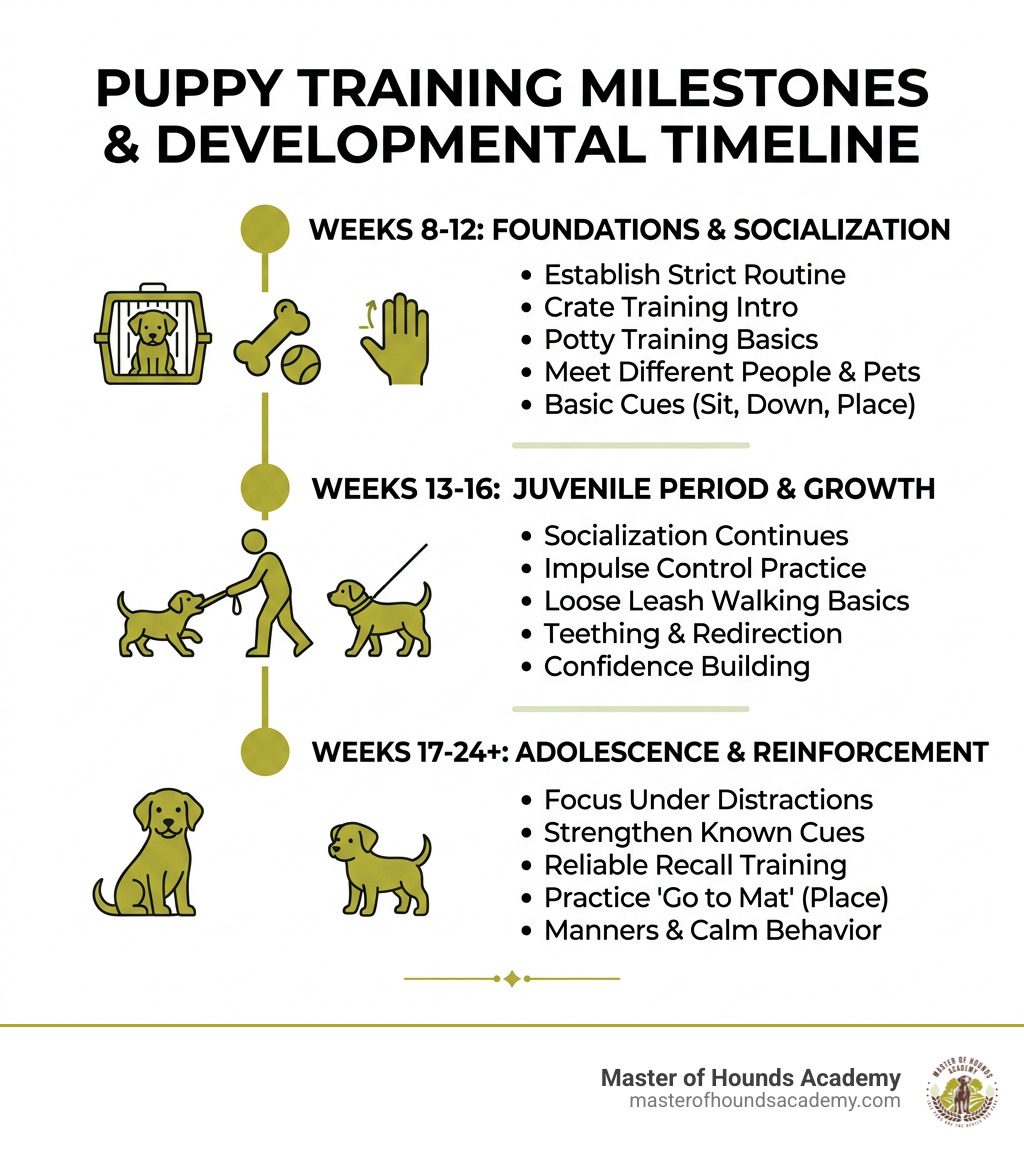
Formal training should begin the very day your puppy arrives in your home, typically around eight weeks of age. The critical socialization and developmental window closes around sixteen weeks. During this formative window, puppies absorb rules, build emotional resilience, and develop environmental neutrality at an astonishing speed. Starting early prevents bad habits from becoming deeply ingrained adult behaviors.
How does a balanced four-quadrant approach work for young dogs?
Our balanced philosophy utilizes all four scientific quadrants of operant conditioning: positive reinforcement, negative reinforcement, positive punishment, and negative punishment. For young dogs, we heavily emphasize clear rewards, guidance, and praise to build new behaviors and teach vocabulary.
As the pup matures and understands our expectations, we introduce fair, calm boundaries and gentle leash pressure to create accountability. This balanced approach gives the dog clear, black and white communication without confusion or endless negotiation.
Can in-home coaching help with fearful or reactive puppies?
Yes. In home private lessons are the gold standard for shy, fearful, or highly excitable puppies. In a chaotic group class, an anxious puppy can easily become overwhelmed and shut down. By starting in your tranquil living room in Greenbrae, Concord, or El Cerrito, we can build confidence systematically. We introduce new sights, sounds, surfaces, and safe distractions at a pace that empowers your dog without triggering panic.
Building a Lifetime of Behavioral Harmony
Raising a young dog is an extraordinary journey that transforms an unruly little ball of fluff into a loyal, well behaved family member you can proudly take anywhere across the Bay Area. Success does not happen by accident; it is the natural outcome of structured daily routines, clear communication, and consistent follow through.
At Master of Hounds Academy, we treat your household like family. Whether you are navigating your very first puppy or welcoming a new canine companion into your retirement years, our customized personalized private lessons give you the exact tools, confidence, and hands on guidance needed to create lifelong behavioral harmony. Reach out to our dedicated team today to begin your training journey.