

Getting a Puppy to Sleep Through the Night Starts With Realistic Expectations
Getting a puppy to sleep through the night takes a steady routine, a safe sleeping space, and patience while their bladder control catches up with their big personality.
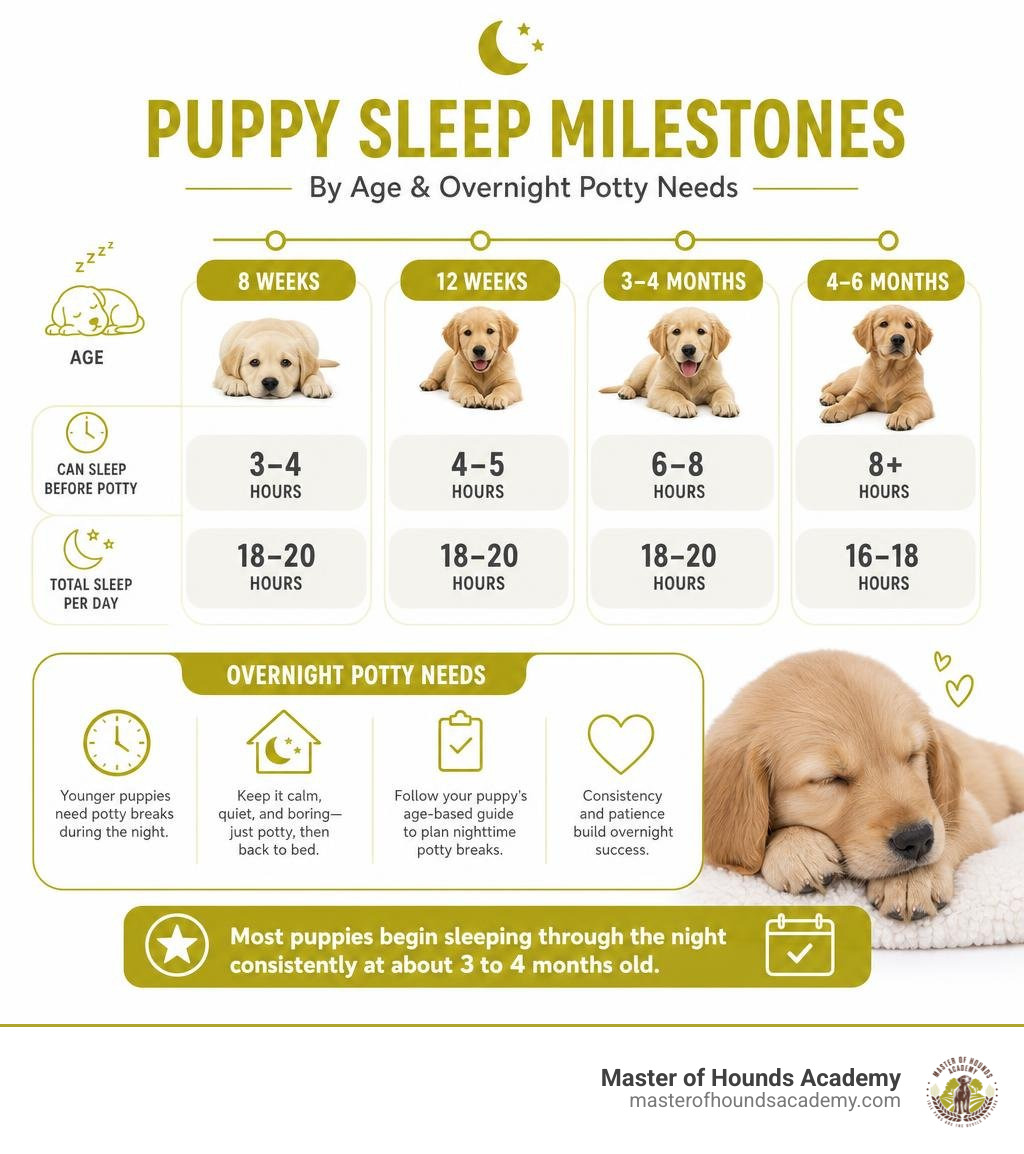
Quick answer: Most puppies begin sleeping through the night consistently at about 3 to 4 months old. At 8 weeks, many puppies can only sleep for 3 to 4 hours before needing a quiet potty trip. Young puppies also need roughly 18 to 20 hours of total sleep each day, so a fussy evening puppy may be overtired, not full of extra energy.
A new home is a very big change for a very small dog. With clear bedtime habits and calm boundaries, your puppy can learn that nighttime is for resting, not hosting a tiny midnight party.
I am Francis Metcalf, founder and co owner of Master of Hounds Academy, and I have spent more than tgrew decades helping families build practical routines around getting a puppy to sleep through the night. The five simple steps ahead will help you create a calmer evening for both your puppy and your household.
Step by Step Blueprint for Getting a Puppy to Sleep Through the Night
When families in Berkeley or San Francisco bring home a new four legged family member, nighttime sleep is usually the very first hurdle they encounter. Teaching a young dog to sleep calmly until morning is not about forcing them into submission or waiting around for exhaustion to set in. It is about creating a predictable structure that guides their physiology and behavior toward rest.
At Master of Hounds Academy, we use a clear framework that leverages operant learning principles across all four quadrants. By rewarding desired calm states and providing consistent, clear boundaries around unwanted middle of the night disruptions, we give puppies the security they crave. Here is our step by step blueprint for success.
Step 1: Establish a Balanced Evening Wind Down Routine
One of the most frequent mistakes new owners make is attempting to exhaust a bouncing puppy right before bed with vigorous games of fetch or intense tug. While it seems logical to tire out a puppy, high arousal play spikes cortisol and adrenaline. These stress hormones linger in the bloodstream and turn an otherwise sleepy dog into a hyperactive tornado at 9 PM.
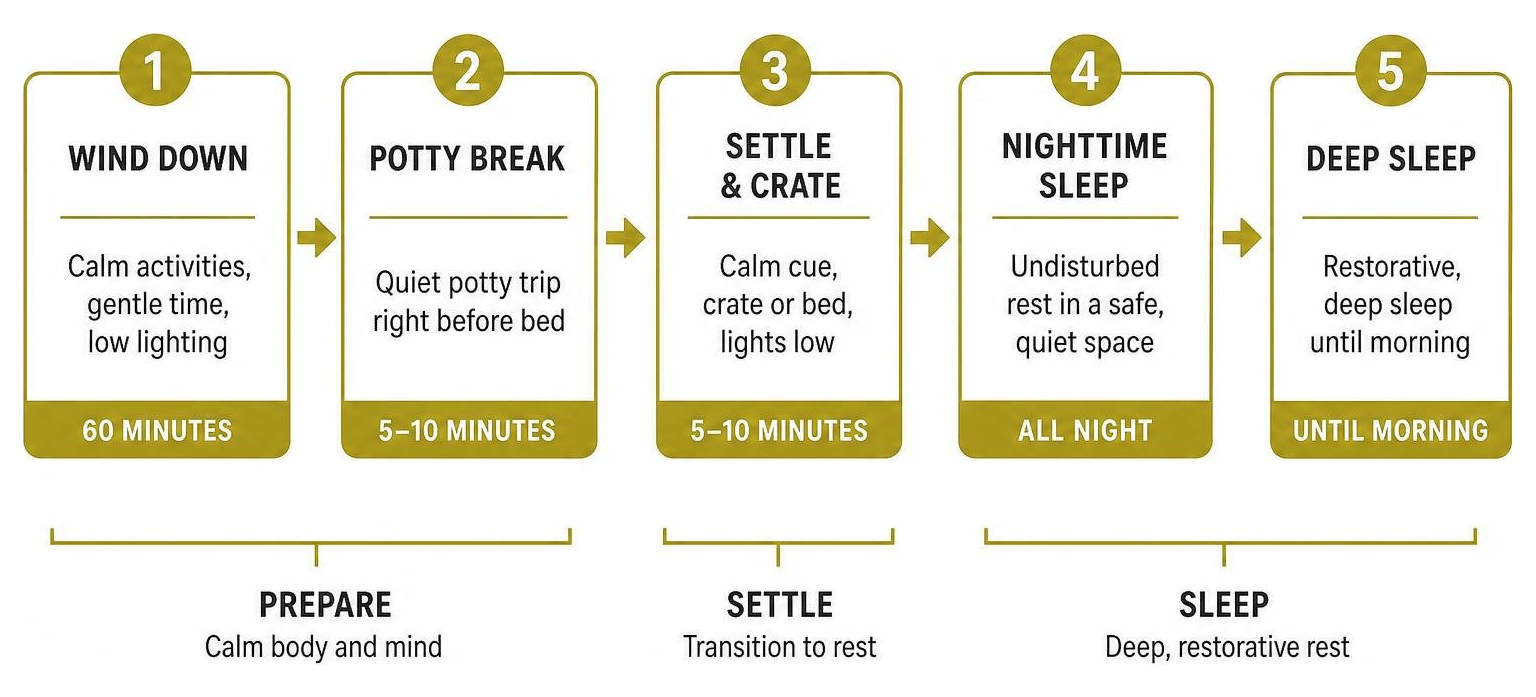
Instead, bedtime success is built downstream from the entire evening. We recommend starting a dedicated 60 minute wind down sequence before lights out:
- Schedule the final meal early: Feed your puppy their last full meal roughly 3 to 4 hours before bedtime. This timing allows the gastrocolic reflex to process the food and gives your pup ample opportunity to pass stool before long term crating.
- Manage water thoughtfully: You do not need to dehydrate your puppy, but lifting the main water bowl about 2 hours prior to bed prevents a full bladder right at lights out.
- Lower environmental stimulation: Turn down bright overhead lights, turn off loud television shows, and speak in quiet tones. Dogs naturally synchronize their circadian rhythms with environmental cues.
- Engage in calm mental work: Replace physical running with slow scent work or simple nose games. Sniffing and foraging naturally lower heart rates and shift your puppy into a rested state.
For a detailed walkthrough of this pre bed routine, explore our guide on the Puppy Bedtime Routine: The 60 Minute Wind Down That Actually Works | Pawpy Blog .
Step 2: Set Up an Inviting Crate Environment
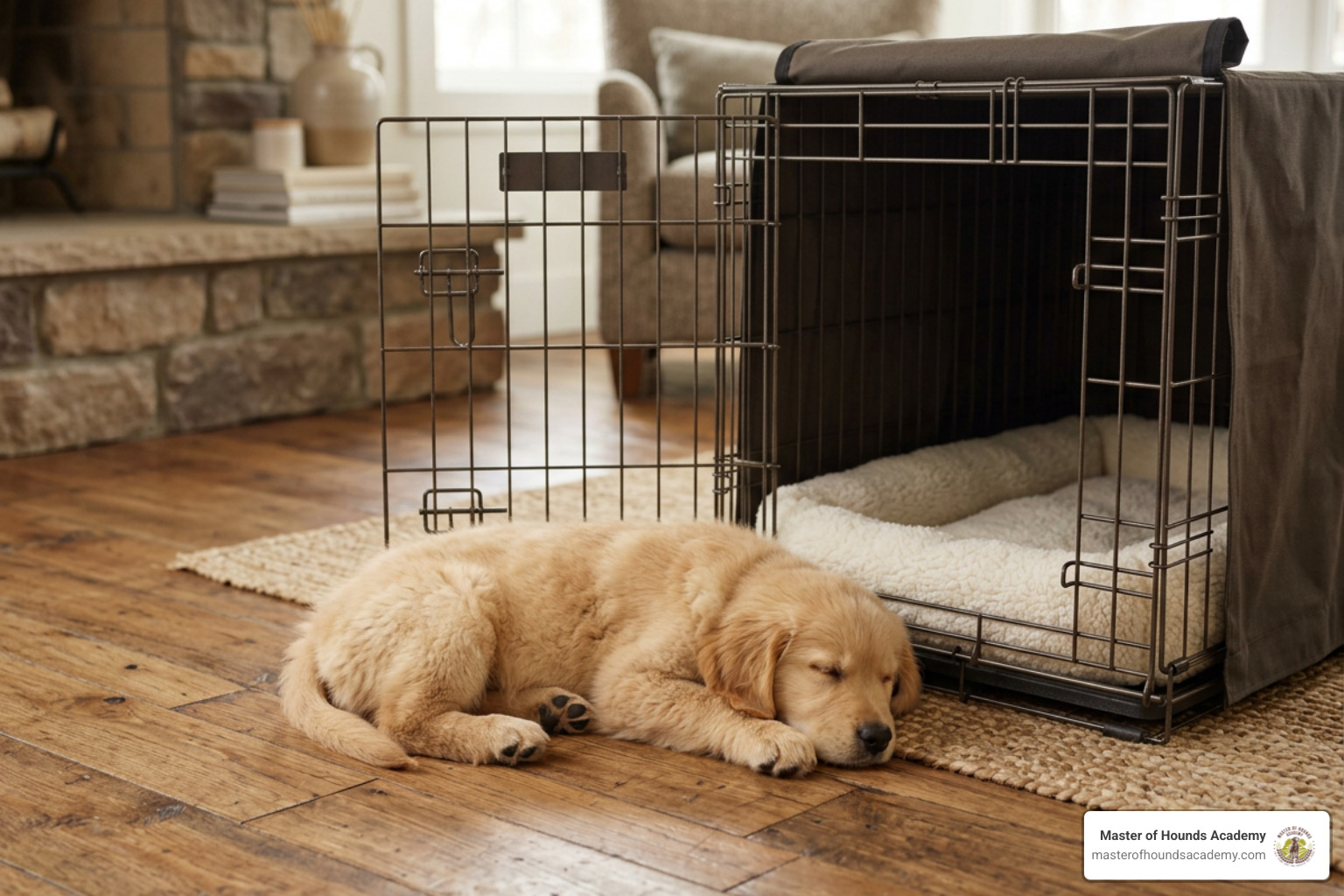
A crate should serve as your puppy’s cozy den, offering security, warmth, and complete safety overnight. To make the crate a space where your puppy willingly settles, carefully evaluate light, sound, and comfort.
Position the crate in a peaceful room free from drafts or extreme temperature swings. A dark environment supports natural melatonin production, which begins calibrating in puppies around 12 to 16 weeks of age. Covering the crate with a breathable sheet or specialized crate cover creates a cave like security that reduces visual triggers.
Adding a white noise machine or low mechanical fan blocks sudden domestic noises like street traffic in Oakland or doors closing down the hallway. To encourage immediate relaxation when you shut the crate door, offer a safe, durable chew toy or a frozen lick mat inside the crate. The repetitive action of chewing and licking stimulates parasympathetic pathways, helping your dog self soothe into deep sleep.
If you want additional perspective on crate setups, review this article on How To Get a Puppy To Sleep Through the Night | Chewy .
Step 3: Master the Late Night Potty Protocol
Overnight potty trips must remain strictly business. If your puppy learns that waking up at 2 AM leads to affection, playtime, or tasty kitchen treats, they will happily repeat the performance every single night.
To prevent your puppy from learning that whining controls your movement, we recommend using preemptive alarms. Instead of waiting for your puppy to scream and responding reactively, set your alarm clock 15 minutes before your puppy typically wakes up to eliminate.
When the alarm sounds:
- Walk quietly to the crate without talking or giving lavish affection.
- Clip on the leash and carry or walk your puppy directly to their designated outdoor potty spot.
- Stand quietly and give them two to three minutes to do their business.
- When they finish, deliver a quick, calm verbal marker, place them immediately back in the crate, close the door, and walk away.
As your puppy grows, implement a wake to pee taper. Every three consecutive nights without an accident or fussing, push your preemptive alarm forward by 15 to 30 minutes. Over a few short weeks, that middle of the night alarm naturally merges with your regular morning wake up time.
Learn more about managing nighttime transitions in Surviving the First Night Home with Your New Puppy: How to Train Your Puppy to Sleep Through the Night .
Step 4: Implement the Bedside Fading Technique
For an 8 week old puppy, moving from a warm pile of littermates to a solitary crate in an empty room can feel overwhelming. Placing the crate directly beside your bed during the initial nights provides vital emotional security.
We use a structured 14 day fading framework to move your puppy from bedside comfort to their permanent sleeping location:
- Days 1 to 3: Position the crate at eye level or immediately next to your mattress so your puppy can hear your breathing and sense your presence.
- Days 4 to 6: Keep the crate next to the bed, but refrain from inserting fingers through the crate bars when your puppy fusses, as this creates a persistent dependency.
- Days 7 to 9: Shift the crate two to three feet away from your bed toward the bedroom door.
- Days 10 to 12: Move the crate near the bedroom doorway or just outside in the hallway with the door open.
- Days 13 to 14: Place the crate in its permanent destination, whether that is the living room, kitchen, or dedicated dog room.
If your puppy experiences a temporary surge in vocal protest during any step, hold your ground at that specific distance for an extra two nights before moving further away.
Step 5: Address Crying with Clear Boundaries
Distinguishing genuine distress from protest crying is an essential skill for every puppy parent. A young dog testing boundaries will often whine, bark, or scrabble at the crate door simply because they would prefer to be on the couch or sleeping on your duvet.
In balanced training, clear communication means helping your puppy understand that crying inside the crate yields zero reward or attention. If you have confirmed that your puppy’s physical needs are met (they have eliminated, they are not in physical pain, and they are comfortable), allow them the opportunity to work through their frustration.
Caving in and opening the crate door while a puppy is actively vocalizing reinforces that exact vocal behavior through operant conditioning. The puppy learns that noise opens doors. Instead, wait for a quiet lull of at least 5 to 10 seconds before approaching or engaging. By pairing consistent rules with calm rewards for quiet postures, your puppy quickly learns that silent composure is the fastest path to freedom.
For additional expert insights on balancing crate expectations, visit Getting Your Puppy To Sleep Through The Night | .
Understanding Puppy Sleep Requirements and Bladder Capacity

Achieving success with getting a puppy to sleep through the night requires working alongside your dog’s physical development rather than fighting against it. Expecting an 8 week old puppy to hold their bladder for eight continuous hours is biologically impossible.
Age Milestones for Getting a Puppy to Sleep Through the Night
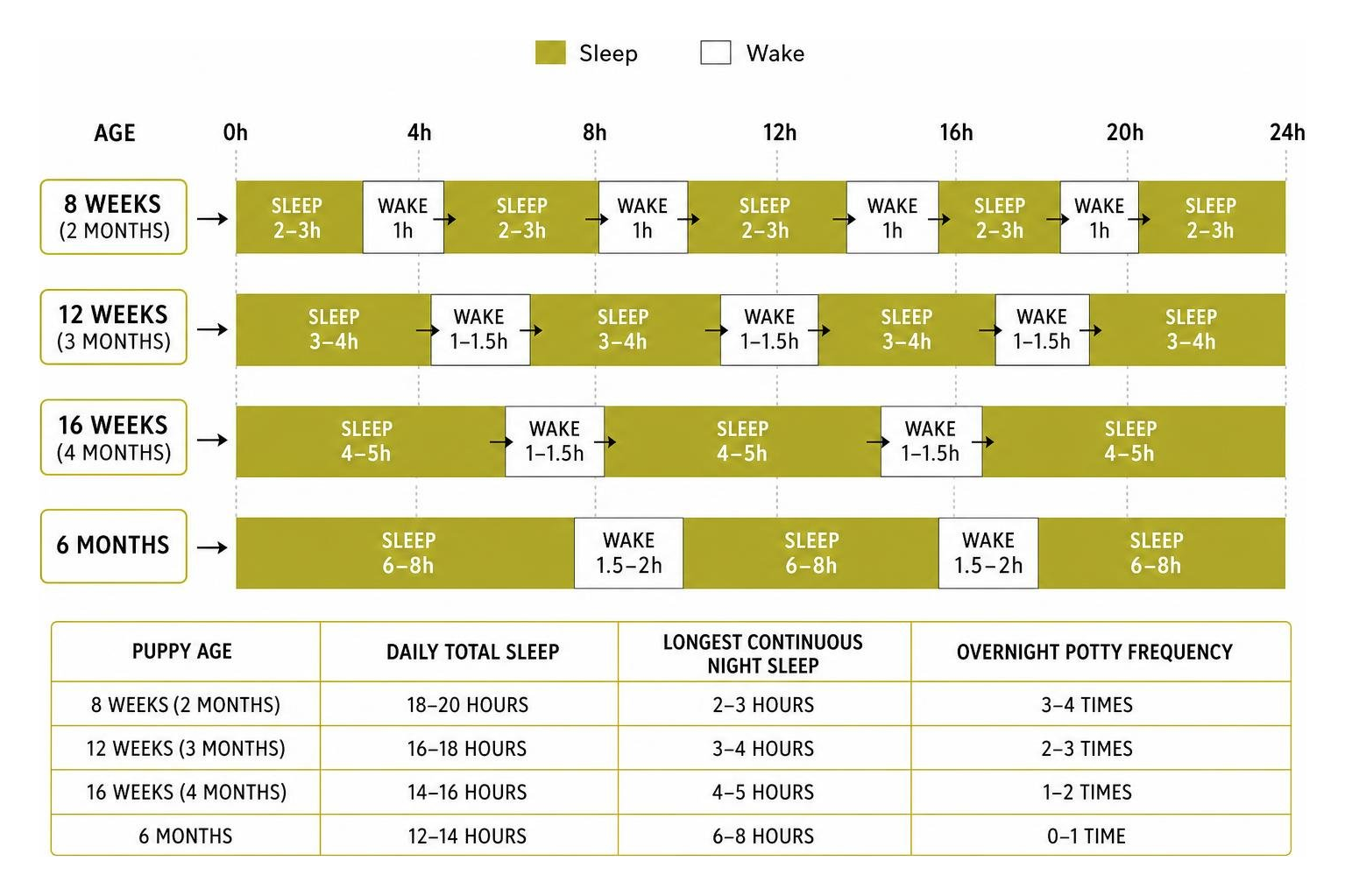
A reliable formula for estimating a puppy’s resting bladder capacity is their age in months plus one hour. An 8 week old (2 month old) puppy can hold their bladder for roughly 3 hours while resting, whereas a 12 week old (3 month old) puppy can manage roughly 4 hours.
| Puppy Age | Daily Total Sleep | Longest Continuous Night Sleep | Overnight Potty Frequency |
|---|---|---|---|
| 8 to 10 Weeks | 18 to 20 Hours | 3 to 4 Hours | 2 to 3 Trips |
| 10 to 12 Weeks | 18 to 19 Hours | 4 to 5 Hours | 1 to 2 Trips |
| 12 to 16 Weeks | 16 to 18 Hours | 5 to 6 Hours | 1 Trip |
| 16 to 20+ Weeks | 14 to 16 Hours | 6 to 8+ Hours | 0 Trips |
By the time most puppies reach 16 weeks of age, their bladder capacity and kidney maturity allow them to sleep 6 to 8 hours uninterrupted. Individual temperament and size also play significant roles. Toy breeds with tiny bladders often take longer to bridge this gap than large breed puppies. Learn more about how temperament shapes learning speed in A Guide to Dog Personalities.
Polyphasic Sleep and Daily Sleep Needs
Puppies do not sleep in one single continuous block like human adults do. Canine sleep is polyphasic, meaning it occurs in multiple short bursts spread across twenty four hours. A puppy’s sleep cycle lasts only 16 to 20 minutes, compared to a human’s 90 minute REM cycle.
Because puppies transition through light sleep states very frequently, they are easily awakened by minor household sounds. Young puppies need between 18 and 20 hours of cumulative rest every day to process learning, support bone growth, and regulate their immune systems. When puppies do not receive enough daytime naps, elevated stress hormones create nighttime hyperactivity and sleep resistance.
To understand the biological mechanisms behind canine sleep patterns, consult Puppy Sleep Training: The Science of Teaching Your Puppy to Sleep Through the Night | Pawpy Blog .
Troubleshooting Nighttime Waking and Behavioral Distractions
Even with a flawless routine, puppies experience occasional nighttime disruptions. Knowing how to interpret your puppy’s signals keeps your training on track.
Differentiating Potty Needs from Attention Crying
Responding appropriately requires knowing whether your puppy is communicating a physical emergency or seeking social attention.
| Behavioral Indicator | Potty Urgency Signal | Attention Seeking Protest |
|---|---|---|
| Sound Characteristics | Sudden, rhythmic whining or sharp barking after sleeping quietly | High pitched, persistent Yipping or howling immediately upon crating |
| Body Language | Pacing, circling, scrabbing at floor, tense posture | Looking directly at you, tail wagging between vocalizations, mouth licking |
| Timing | Waking up 3 to 4 hours into a sleep cycle | Occurring within 5 to 15 minutes of closing crate door |
| Response Outside | Marches straight to grass, eliminates within 60 seconds | Sniffs aimlessly, tries to play, grabs leaves, sits by your feet |
Common Root Causes of Night Waking
When a previously quiet puppy suddenly starts waking up during the night, consider these underlying triggers:
- Overtiredness and overarousal: Skipping afternoon naps causes cortisol spikes, leading to late night tantrums that look like boundless energy.
- Teething discomfort: Between 12 and 24 weeks, emerging adult teeth create sore gums. Offering a chilled chew ring before bed provides welcome relief.
- Late feeding times: Meals given too close to bedtime digest overnight, triggering gastrocolic reflexes at 3 AM.
- Medical disruptions: Urinary tract infections (UTIs), intestinal parasites, or sudden dietary upsets increase urgency. If your puppy wakes repeatedly every hour, schedule a checkup with your veterinarian.
Professional Support for Getting a Puppy to Sleep Through the Night
If nighttime crying persists beyond two weeks despite a consistent schedule, or if your puppy displays severe panic, frantic clawing, or self harm inside the crate, professional guidance is invaluable.
At Master of Hounds Academy, our Metcalf Method blends personalized behavioral evaluations with structured, real world solutions tailored to Bay Area families. Whether you live in Marin, Alameda, or Walnut Creek, our balanced training programs help resolve deep seated sleep anxieties and build lasting harmony in your home.
Frequently Asked Questions About Puppy Sleep
How many hours of sleep does a young puppy need each day?
Young puppies between 8 and 16 weeks old require roughly 18 to 20 hours of sleep per day. This rest is split between overnight sleep and multiple scheduled naps throughout the morning, afternoon, and early evening.
What should I do if my puppy starts crying in the middle of the night?
First, calmly evaluate the timing. If it has been several hours since their last trip outside, conduct a quiet, business only potty trip without talking, play, or treats. If they eliminated recently and are simply protesting, use firm boundaries and allow them to quiet down without opening the crate door during active vocalization.
When can a puppy hold their bladder for 8 hours straight?
Most puppies gain the physical bladder maturity and muscle control needed to hold their bladder for 8 hours straight between 4 and 5 months (16 to 20 weeks) of age, provided they received proper daytime potty scheduling and balanced crate training.
Building Lasting Sleep Habits for Your Puppy
Mastering getting a puppy to sleep through the night is one of the most rewarding milestones in early puppy raising. By combining early evening wind downs, safe crate setups, proactive potty schedules, and clear behavioral boundaries, you provide your puppy with the structured environment they need to thrive.
Progress is rarely a perfectly straight line. Growth spurts, teething, and developmental phases bring minor bumps along the road, but staying consistent with your rules ensures long term success.
If you want personalized coaching to guide your puppy through crate training, housebreaking, or household manners, explore our customized options for Personalized Private Dog Training Lessons. With our three decades of experience helping families across the Bay Area, we are here to help you and your puppy enjoy peaceful nights and bright mornings together.